


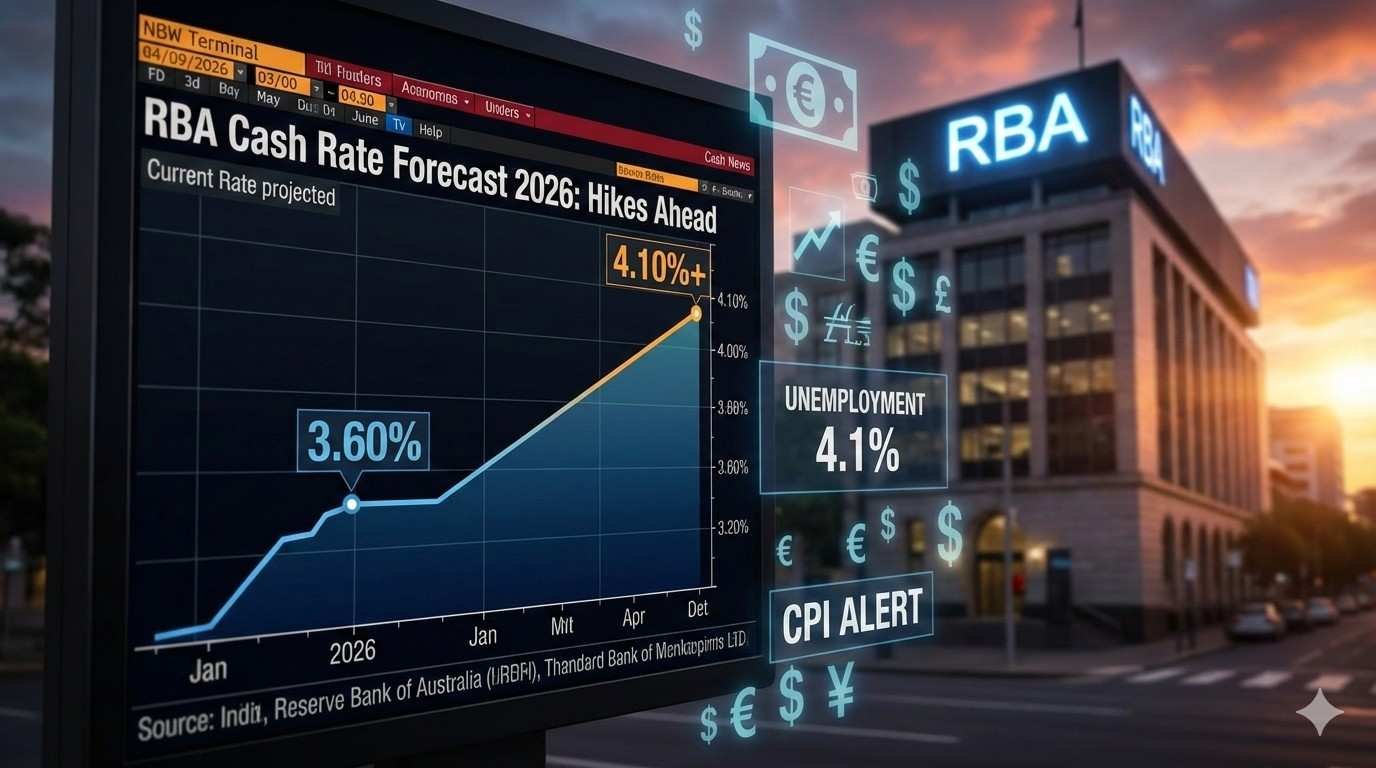
RBA Rate Hike Alert: Australia’s story took an unexpected turn yesterday. Until well into 2025, the Australian people had been convinced that the economy was ready to witness a string of interest rate cuts. But that story has ended. After a run of “hot” Australian data, the market now treats a 25bp rate hike by May 2026 as certain – and another increase soon to follow.
Change in Interest Rate Policy: This pivotal shift represents a major inflection point in the history of the Reserve Bank of Australia. After cutting rates throughout 2025, the central bank is now facing the cold hard facts: inflation will not remain subdued, as it is forced by a labor market far better than anyone could have predicted.
The Labor Market Shock: Why the RBA is Reconsidering
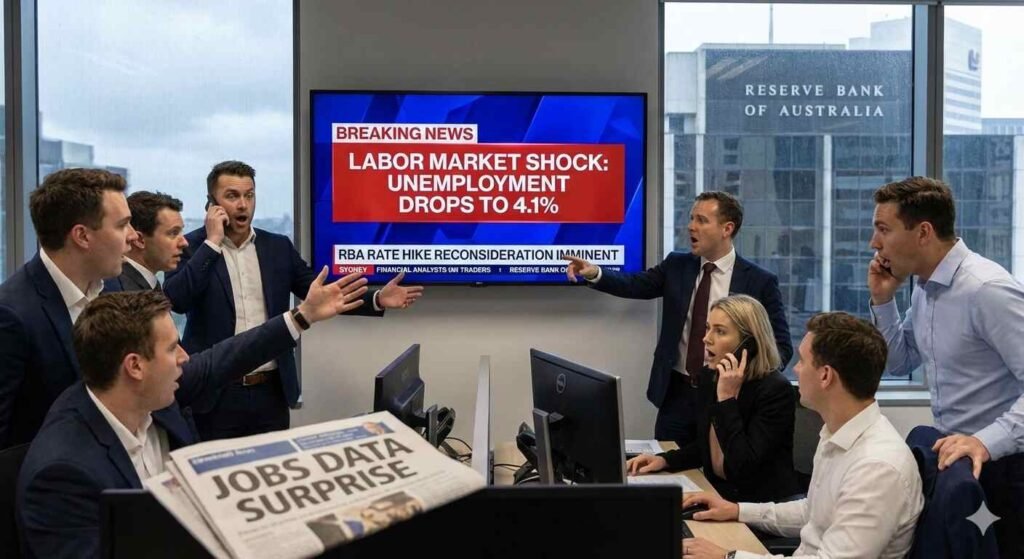
The primary catalyst for this hawkish shift is the December labor force data. While the RBA and most economists expected the economy to cool down, the numbers told a different story.
Unemployment Defies Gravity at 4.1%
In a result that caught the market off guard, the unemployment rate fell to 4.1% in December, down from 4.3% in November. This is significantly lower than the RBA’s own forecast of 4.4%. When unemployment stays this low, it creates “sub-NAIRU” conditions—meaning the labor market is so tight that it naturally pushes wages and inflation higher.
Record-Breaking Hours Worked
It wasn’t just the headline unemployment rate that surprised analysts. The Australian economy added a massive 65,200 jobs in a single month, with full-time positions making up the bulk of that growth. For the first time in history, total monthly hours worked in Australia exceeded 2 billion, signaling that businesses are still in a hiring and expansion phase despite higher borrowing costs.
Banking Giants Revise 2026 Forecasts
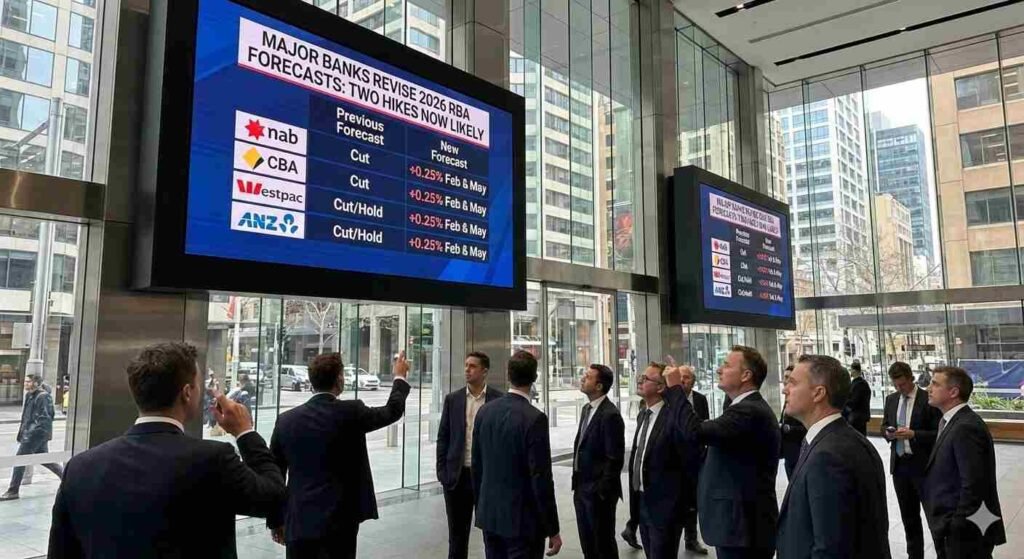
With the data shifting, Australia’s “Big Four” banks are rapidly updating their playbooks. The consensus has shifted from “when will rates fall?” to “how high will they go?”
- National Australia Bank (NAB): NAB economists have made a bold call, predicting two 0.25% increases in 2026, specifically targeting the February and May meetings.
- Commonwealth Bank (CBA): Previously expecting a hold or cut, CBA has joined the hawkish camp, now forecasting a rate hike as early as February to get ahead of inflationary pressures.
- Market Pricing: Bloomberg data shows that traders are now anticipating at least 44 basis points of total hikes throughout 2026, which would take the cash rate from its current 3.60% toward 4.10%.
The “Sticky” Inflation Problem

The RBA’s biggest headache remains Services Inflation. While the price of goods (like electronics or clothes) has stabilized, the cost of services—rents, medical care, and insurance—remains stubbornly high.
Current Governor Michele Bullock has been clear in her recent communications: interest rate cuts are “not on the horizon for the foreseeable future.” The RBA Board is now actively discussing circumstances where a rate increase might be necessary to ensure inflation returns to the 2–3% target range.
Unlike the previous Governor, Philip Lowe, Bullock faces a unique challenge where the rate cuts delivered in 2025 may have been “premature,” potentially making the RBA the first major central bank to pivot back to hikes after a brief easing cycle.
What This Means for Mortgage Holders

For the millions of Australians with variable-rate home loans, this news is a tough pill to swallow. After experiencing some relief in 2025, the prospect of rising repayments is back on the table.
| Loan Amount | Estimated Monthly Increase (per 0.25% hike) |
|---|---|
| $600,000 | +$90 |
| $750,000 | +$115 |
| $1,000,000 | +$155 |
Fixed-rate markets are already reacting. In December alone, over 40 lenders increased their fixed-rate offerings, anticipating that the RBA will follow through with its hawkish signals in early 2026.
Investor Strategy: Navigating a Higher-for-Longer Environment

As the “higher-for-longer” mantra returns, investors need to adjust their portfolios.
- Yield over Growth: High-interest rates typically pressure high-growth tech stocks. Investors are moving toward cash-flow-heavy sectors like resources and energy.
- Banking & Real Estate: While banks might benefit from higher margins, the real estate sector and consumer-discretionary stocks (retail) could face headwinds as household budgets tighten further.
Conclusion: All Eyes on the Next Inflation Print
The era of expecting easy money and rapid rate cuts is officially over. Australia’s resilient economy and red-hot job market have forced the RBA’s hand. While the bank would prefer to stay on hold, the risk of “entrenched inflation” is too high to ignore.
The Q4 inflation data (due next week) will be the final piece of the puzzle. If those numbers come in higher than expected, a February hike is almost certain. For now, Australians should prepare for a more expensive 2026.
Frequently Asked Questions (FAQs)
Why is the RBA suddenly signaling rate hikes instead of cuts?
The main culprit is Australia’s incredibly resilient labor market. While everyone expected the economy to slow down, December 2025 data showed unemployment dropping to 4.1%. When the job market is this “hot,” it creates a risk of wage-driven inflation. To keep prices from spiraling, the RBA has to pull the handbrake by raising interest rates.
What is the current Australian cash rate as of January 2026?
Currently, the cash rate sits at 3.60%. It’s important to note that this is lower than the 4.35% peak we saw in 2024, thanks to a few rate cuts delivered throughout 2025. However, with the new economic data coming in, that downward trend is now reversing.
When exactly is the first rate hike expected to happen?
Financial markets are currently “pricing in” a 100% chance of a rate hike by May 2026. However, some major banks, including NAB and CBA, believe the RBA might move even sooner, potentially as early as the February meeting, depending on the upcoming quarterly inflation figures.
How much will a 0.25% rate hike actually cost me each month?
It depends on your loan balance, but here is a quick rule of thumb: for every $600,000 of debt on a variable mortgage, a 0.25% increase will add roughly $90 to your monthly repayment. If you have a $1 million loan, you’re looking at an extra $150+ per month.
Is the dream of further rate cuts officially over for 2026?
For now, yes. Governor Michele Bullock has been quite direct, stating that rate cuts are “not on the horizon” for the foreseeable future. Unless there is a sudden and dramatic crash in economic activity, the RBA is firmly focused on fighting “sticky” inflation in the services sector (like rents and insurance).
Should I fix my mortgage rate now before they go higher?
The market is already moving. In December alone, over 40 lenders increased their fixed rates in anticipation of the RBA’s move. While fixing provides certainty, rates are already higher than they were a few months ago. It’s best to speak with a mortgage broker to see if “locking in” makes sense for your specific financial situation.
My website Recent Article: Naomi Osaka Australian Open 2026 Withdrawal
