


Odessa A’zion has just made a move that has definitely not gone unnoticed in Hollywood. The “Marty Supreme” actress has just announced her exit from Sean Durkin’s upcoming film “Deep Cuts” due to whitewashing allegations surrounding her character.
Taking to Instagram on Wednesday night, A’zion made no bones about her stance on the issue. “Guys!! I am with ALL of you and I am NOT doing this movie,” she posted in her Instagram Stories, accompanied by a resounding “F–k that”. It’s clear that there has been a growing awareness of representation in films lately, particularly in regards to ethnicity and cultural accuracy in casting choices. This particular controversy shows how the actors themselves are taking a more active role in addressing these concerns directly.
In this article, we will discuss what led to the whitewashing allegations, look at the industry’s reaction to this controversy, and discuss what this might mean for the “Deep Cuts” film and A’zion’s acting career in the future.
Odessa A’zion Leaves ‘Deep Cuts’ Over Casting Dispute
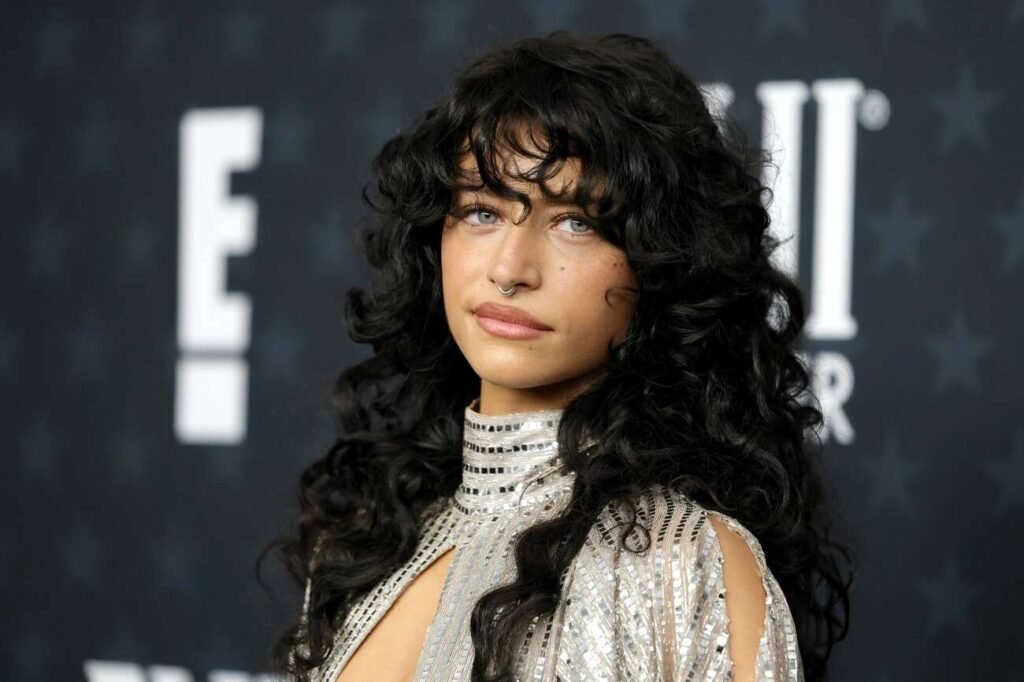
Only 48 hours after her casting was announced, Odessa A’zion announced that she would no longer be a part of Sean Durkin’s new film “Deep Cuts” for A24 due to the rising criticism of whitewashing. The controversy began when fans realized that the character Odessa A’zion was to play, Zoe Gutierrez, is half-Mexican and half-Jewish in Holly Brickley’s 2023 novel.
Actress confirms departure through social media
In a series of Instagram Stories posted late Wednesday, January 28, Odessa A’zion confirmed the departure from the film with no ambiguity. “Guys!! I am with ALL of you and I am NOT doing this movie,” she posted, later adding, “F*** that. I’m OUT”. The move came after several fans expressed their concerns about an actress of non-Mexican descent playing the role.
A’zion went on to give a full explanation of how she was cast in the film. “I went in for Percy, but was offered Zoe instead and instantly said yes!” she posted. The 25-year-old actress admitted that she hadn’t read the book before accepting the role, which she now regrets. “I’m so pissed y’all, I hadn’t read the book and should have paid more attention to all aspects of Zoe before accepting… and now that I know what I know???”
In addition, A’zion admitted that she would never consider taking a part that was intended for a character with the right cultural background. “I’d never take a role from someone else that’s meant to do it. That SHOULD do it! That’s not me,” she added. In addition, she hoped that the casting would eventually go well, saying, “There are a plentitude of people more than capable of playing this role and I am NOT one of them. I can’t wait to see who it ends up being”.
The actress further clarified that even if she has not read the book yet, she understood the significance of representation after the fans informed her about the issue. “Still haven’t read the book but the story in the script is focused on Percy and Joe, so of course on my initial read that was my main focus as well,” she clarified. Nevertheless, A’zion concluded, “I was happy to be involved as a different role, but I just can not do it knowing more about Zoe now”.
Production team issues brief statement
At the time of this writing, the production team for “Deep Cuts” has kept a rather low profile in light of the controversy. According to HuffPost, representatives for A’zion and A24 did not immediately respond to requests for comment. This is rather unusual in light of the actress’s direct handling of the situation.
The movie version of “Deep Cuts” is still in its early stages, with production yet to begin. The casting announcement that caused this controversy was first reported by The Wrap, and this news quickly made its way through entertainment news sites before causing the online backlash that led to A’zion’s change of heart.
This controversy has certainly brought attention to casting procedures and the role of actors and production companies in ensuring proper representation, especially in the context of adapting characters from a particular cultural background. However, industry insiders are now waiting to see what will happen next regarding the recasting of the character Zoe Gutierrez.
What Sparked the Whitewashing Allegations?
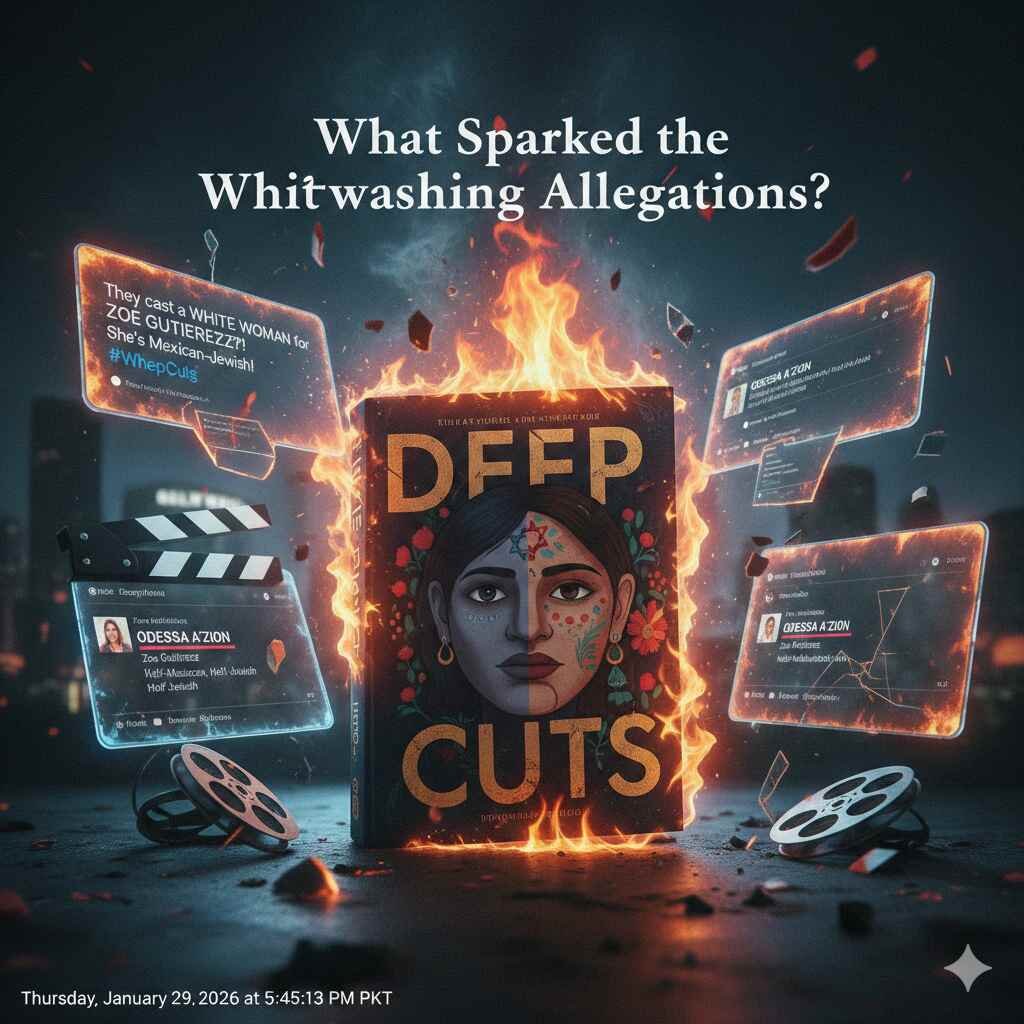
The controversy over “Deep Cuts” began as soon as the casting announcements were made public. At the center of this controversy is a rather pressing question about representation in Hollywood productions that has been increasingly brought to the fore in recent years.
Casting of lead character attracts criticism from fans
The criticism began when fans of Holly Brickley’s novel realized that Odessa A’zion had been chosen to play the part of Zoe Gutierrez, who is described in the book as being half-Mexican and half-Jewish. Fans of the book quickly pointed out that while A’zion is Jewish, she is not of Mexican descent. This was seen as a problem, as it appeared that the character’s Mexican heritage was being erased.
In essence, the problem that arose with the casting of the lead character is a problem that has long existed in Hollywood film. This problem is the casting of actors to play characters of a certain ethnic background when they are not of that background. Fans of the book were upset that the character was not played by a Latina actress, who could have represented the Mexican heritage of the character.
Backlash on the internet points to lack of representation
The backlash on the internet was quick and widespread. The internet became a forum for fans to discuss the issue of representation and the role that both actors and production companies have in ensuring that representation is accurate. One of the posts that went viral on the internet was a tweet that said, “Casting a white woman to play a Mexican role at a time when Latinos in this country are afraid to leave their houses for fear of their government kidnapping them is so gross”.
In addition to these issues, several individuals brought up Mexican actresses who could have been considered for the part, such as Melissa Barrera and Eiza Gonzalez, both of whom were born and raised in Mexico. The timing of this controversy, in light of the current political climate of increased tensions over immigration policies in the United States, further exacerbated the issue.
Additionally, screenshots on social media alleged that Brickley had made a statement to a fan on direct message that the character would “surely” be rewritten, as it “happens all the time.” This further contributed to the outrage of critics who saw this as a representation of source material being changed to fit mainstream casting desires.
Cultural significance of the character in question
In the context of Brickley’s novel, the importance of Zoe Gutierrez’s cultural identity cannot be overstated. Her Mexican and Jewish heritage is an essential part of her character development and emotional arc in the story. This is an important part of her identity that readers felt should be maintained in any form of adaptation.
It is also important to note that this particular controversy is not the only instance of this kind of Hollywood dispute. There have been several instances in the past that have been cited as examples of this kind of problem. These include Scarlett Johansson’s casting as a Japanese character in “Ghost In The Shell” and Emma Stone’s portrayal of a character of Chinese and Hawaiian descent in “Aloha”. These kinds of instances have led to a growing need for Hollywood to maintain cultural accuracy over marketability.
The particular controversy over “Deep Cuts” is a symptom of a larger issue of representation in the industry. Many people feel that changing character identities or casting outside of character identities is simply a way of maintaining systemic underrepresentation in the industry. As one particular social media user pointed out: “If there are 1000 roles out there for actors. And 50 of those are written for Latinos. LATINOS should play them”.
How Has the Industry Reacted to the Controversy?
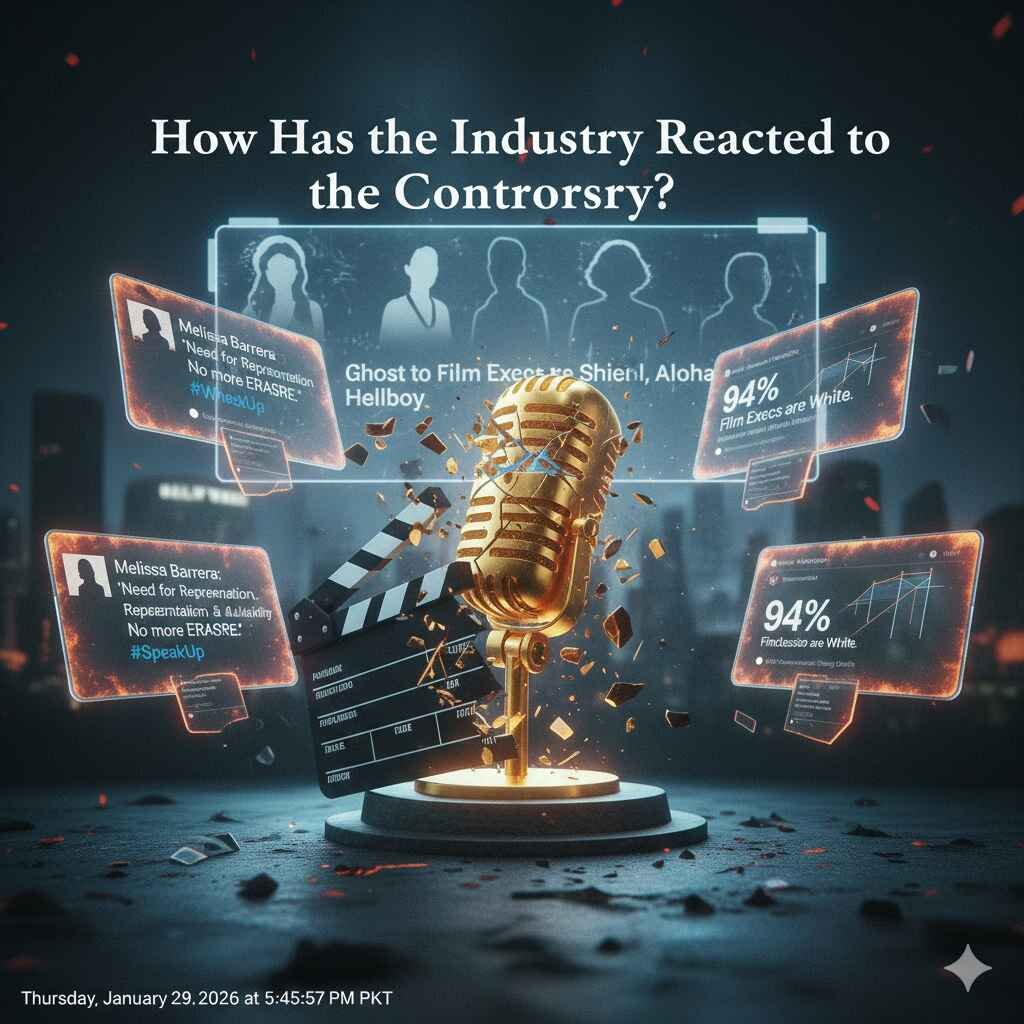
The “Deep Cuts” controversy has sparked a broad industry reaction, with the current tensions over authentic representation in Hollywood being brought to the fore. The controversy over the casting and subsequent withdrawal of Odessa A’zion has brought the issue of casting and accountability to the forefront of debate among industry insiders once again.
Actors and filmmakers take to social media
Melissa Barrera, the fired star of “Scream,” has indirectly commented on the controversy through an Instagram post regarding the “need for representation” and the “erasure” of it in Hollywood, which was seen as a reaction to A’zion’s casting, although she did not mention the project or the actress directly. The reaction to A’zion’s withdrawal from the project has been divided on social media platforms, with some questioning her decision to take the role in the first place and others praising her for standing by her principles.
“This is what real allyship looks like. No press release necessary, just a clear exit. Kudos to Odessa for risking her career for what she believes in,” posted a fan. Others posted their criticism: “It’s rich that she says ‘I’m with all of you’ when she already accepted the role”. Notably, this particular event has been preceded by other casting controversies in the industry recently.
Diversity advocates demand accountability
Groups such as the Media Action Network for Asian Americans (MANAA) have long fought whitewashing in Hollywood films. In response to a petition by the American Civil Liberties Union, the Equal Employment Opportunity Commission launched an investigation into gender discrimination in the film industry, citing studies that found women to be systematically excluded from directing positions.
Media watchdog groups have been increasingly advocating for genuine representation, insisting that characters of particular ethnicities should be portrayed by actors of the same ethnic background. Primarily, these groups believe that if characters of a particular ethnic background are written, actors of that background should be considered first for the part.
Film critics discuss pattern of whitewashing in Hollywood
Film reviewers and industry experts refer to this controversy as one of the many worrying trends. “We don’t have a diversity problem. We have an inclusion crisis,” said USC professor Stacy L. Smith. This view is backed by a report in 2013, which showed that 94% of film executives were white, and that non-white people were underrepresented as filmmakers and actors.
This controversy is the latest in a series of similar ones, including:
- Scarlett Johansson being cast as Japanese character Major Motoko Kusanagi in “Ghost In The Shell”
- Emma Stone being cast as a character of Chinese and Hawaiian descent in “Aloha”
- Ed Skrein quitting the “Hellboy” reboot in 2017 after realizing that the character he was playing was of Asian descent
“‘Of course, there is nothing wrong with race-blind casting, as long as it’s a two-way street. But in reality, it never has been,'” said law professor John Tehranian, who pointed out that non-white actors are rarely cast as white characters. In all these debates, industry insiders have repeatedly argued that whitewashing undermines the authenticity of storytelling while continuing to systemically underrepresent non-white people.
As Pepperdine University film history professor Craig Detweiler said, “There are a shortage of African American, Asian, and Latino stars. For all Hollywood’s progressive politics, its casting choices are remarkably retrograde.”
What Does This Mean for ‘Deep Cuts’ Going Forward?
The departure of A’zion from ‘Deep Cuts’ has a number of ripple effects that the production will have to deal with going forward. With filming set to begin in February 2026, the departure of A’zion means that A24 and director Sean Durkin will have to quickly shift gears in terms of their approach to this adaptation of Holly Brickley’s novel.
The producers are said to be considering recasting options
At present, the production team, including A24 and Durkin, has not made any official statements regarding a replacement for the character of Zoe Gutierrez. Casting for this role is set to begin immediately, given the impending start date of the production. As for the departure of A’zion, A24 has remained tight-lipped, offering no official statement regarding the controversy surrounding her departure or how they plan to deal with the situation.
In light of the casting controversy, fans of the series have called for a number of Latina actresses to take on the role of Zoe Gutierrez, with Melissa Barrera being one of those named by fans in online forums. At present, the film adaptation is still in pre-production, with key talent and crew being hired as the production schedule continues to take shape.
The release timeline may be delayed
The movie had already undergone substantial casting changes before this controversy erupted. It was originally going to feature Saoirse Ronan and Austin Butler, but both left due to scheduling conflicts. Later, the project “pivoted to a pair of the town’s busiest young actors”. As such, any additional casting changes may affect the planned production start in February 2026.
Taking all these factors into consideration, ‘Deep Cuts’ will most likely not see the light of day until 2027, given the average post-production time for similar projects. The author, Brickley, had previously been excited about the production timeline, posting on Instagram: “Minor update. I am beyond thrilled… Shooting starts in February!” As such, this timeline is now in question.
Public trust in the project is shaken
Contrary to what one would expect, the controversy has instead brought the movie ‘Deep Cuts’ into the limelight, making it a point of discussion regarding Hollywood’s approach to adaptations of stories that include culturally specific characters. The controversy has left the author with no choice but to restrict comments on her Instagram posts following demands for recasting.
Questions regarding possible script changes have further undermined confidence, with some speculating that the script was being “rewritten to accommodate whiteness”. Even fan accounts dedicated to the series have taken a stance against the production, with one Twitter account, “Odessa A’zion Daily”, halting activity in protest.
For A24, a company that usually “champions authenticity and specificity in its storytelling,” ‘Deep Cuts’ is now a major problem for these ideals. The series will “likely continue to operate under scrutiny, especially from readers who are invested in Brickley’s novel”.
How Does This Affect Odessa A’zion’s Career?
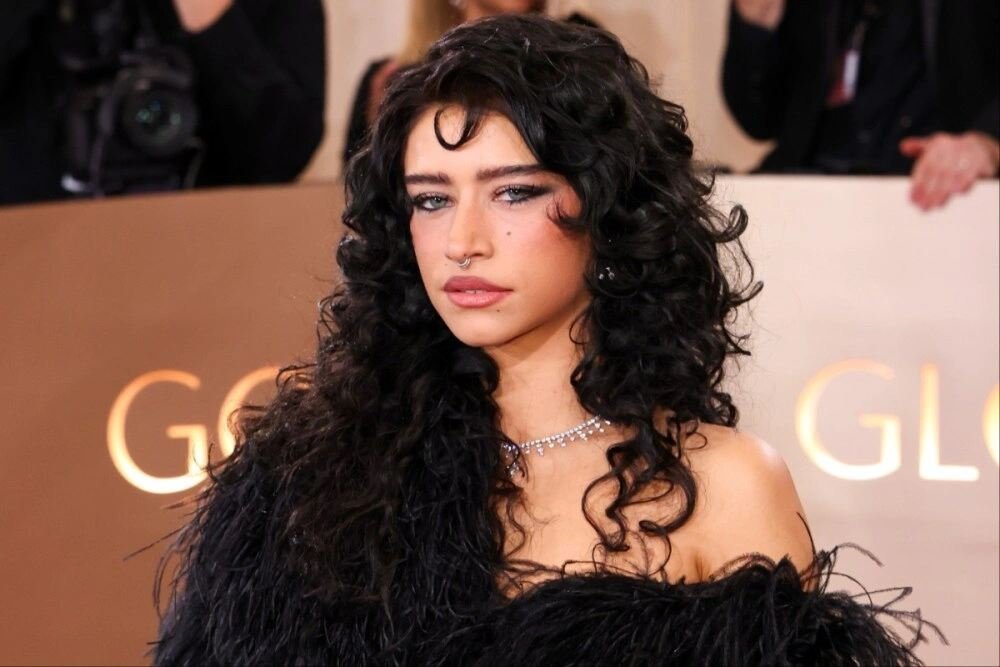
In the wake of the “Deep Cuts” scandal, Odessa A’zion’s career is currently on the rise. Her choice to leave the series has sparked debate regarding her professional and personal life.
Recent roles in ‘Until Dawn’ and other projects
A’zion has recently starred in the film adaptation of “Until Dawn,” playing the role of Nina, released on April 25, 2025. At the same time, she has been working on an impressive resume with roles in “Marty Supreme” with Timothee Chalamet, for which she was nominated for an Actor Award. Currently, she is scheduled to appear alongside Rachel Sennott in a new HBO pilot, directed by Lorene Scafaria. A’zion has also received praise for her performances in “Sitting In Bars With Cake” with Bette Midler and Yara Shahidi, and has finished filming “She Rides Shotgun” with Taron Egerton.
Public support helps her image
During the casting controversy, A’zion received a lot of public support for her stand. Her honest reaction and readiness to admit her mistake impressed the public. In contrast to some situations where actors have defended the casting controversy, A’zion’s immediate withdrawal has shown her understanding, which has largely helped her image.
Discussion on her ethnicity and activism
Apart from her acting career, A’zion has been questioned about her name and ethnicity. As the daughter of Jewish actress Pamela Adlon, she changed her name in 2020 by using her mother’s name and her middle name, Zion. Later, she was criticized for wearing an Israeli Defense Forces t-shirt in a 2017 photo. However, A’zion later explained, “I do not support the IDF or Netanyahu in any way!”, stating that she didn’t understand the meaning of the t-shirt when she was younger.
Conclusion
The moral stand taken by Odessa A’zion in leaving the production of “Deep Cuts” undoubtedly represents a major turning point in the current Hollywood awakening towards genuine representation. The actress’s rapid decision to leave the production following her discovery of Zoe Gutierrez’s Mexican-Jewish background clearly illustrates the personal role that actors can take in making casting decisions. The controversy that has arisen from this incident clearly represents the industry-wide trend in which characters of particular cultural backgrounds are typically represented by actors who lack these backgrounds.
The rapid online reaction to the initial casting of A’zion clearly illustrates the current demand for greater authenticity and accurate representation in film adaptations. The use of social media in drawing attention to this issue has clearly forced both the actress and the film production company to respond to these concerns. Although A24 has thus far remained remarkably quiet on the issue of recasting, this controversy is likely to have a major impact on the future production of “Deep Cuts.”
Industry experts in the film industry have long argued that whitewashing represents a major obstacle in the authentic representation of underrepresented groups in film, while also undermining the authenticity of film storytelling. This particular issue therefore represents a major example of a casting controversy that has arisen in films such as “Ghost In The Shell” and “Aloha.” However, the actress’s honest admission of her mistake and subsequent withdrawal from the production clearly differs from previous examples in which actors have defended casting decisions.
We have also seen a growing spotlight on the casting decisions of Hollywood in recent years. However, it does not seem that A’zion’s career has been affected by this scandal – in fact, her integrity has only served to improve her professional reputation among those who care about genuine representation. The production team must now quickly shift gears, as filming is set to begin shortly, although public confidence in the production has been slightly undermined.
Most importantly, this controversy is a reminder that representation truly does matter, not only for the sake of authenticity but also for the opportunities it provides to actors of underrepresented groups. The fact that there has been such a positive reaction to this casting choice is a testament to the fact that audiences are now demanding that Hollywood make responsible choices in the adaptation of characters with specific cultural identities. However, the fact that A’zion was willing to walk away from a high-profile project with a respected director and studio is a testament to the fact that individual choices can make a difference in bringing about positive change.
FAQs
Q1. Why did Odessa A’zion withdraw from the movie ‘Deep Cuts’?
Odessa A’zion withdrew from the movie ‘Deep Cuts’ because she discovered that the character she was to portray was originally meant to be half-Mexican and half-Jewish in the novel on which the movie is based. She chose to withdraw from the movie in order to promote more accurate representation.
Q2. What was A’zion’s reaction to the whitewashing allegations?
A’zion responded to the controversy on social media, saying that she did not know the original background of the character when she took the role. She showed her support for the casting of an actress who could better represent the background of the character.
Q3. What is the effect of this controversy on the ‘Deep Cuts’ production?
The controversy has led to delays in the production schedule and recasting of the character. It has also led to discussions on representation and casting in Hollywood.
Q4. How did the film industry respond to this incident?
The incident has brought back the debate on representation in the film industry, with many actors, directors, and representatives of diversity in the industry calling for better casting practices in Hollywood productions.
Q5. What does this incident reveal about the current state of casting practices in Hollywood?
This incident reveals the problems that exist in the film industry in Hollywood in terms of representation, especially when it comes to characters from certain backgrounds.
Explore More from Orbit News Hub: Apple Creator Studio
