


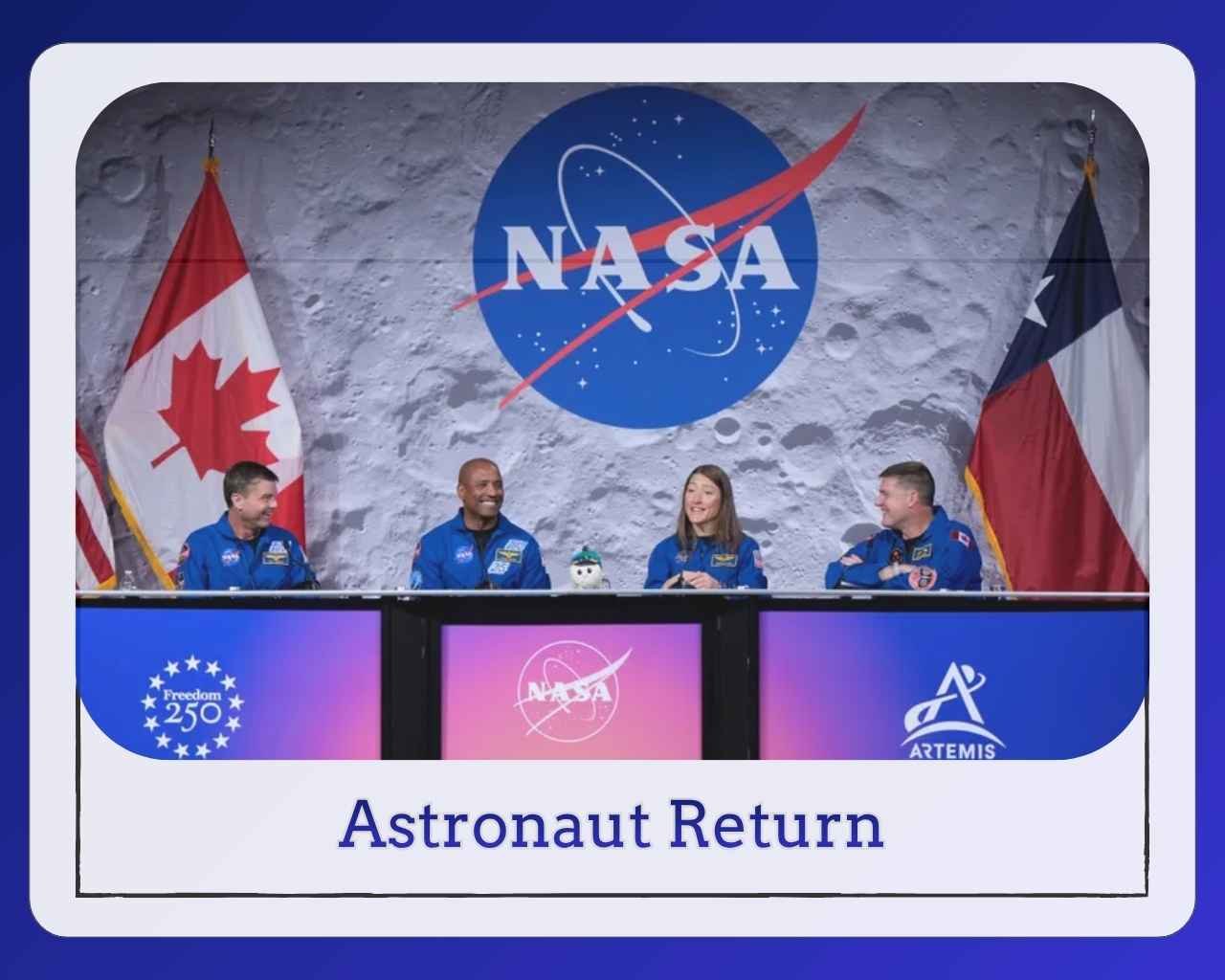
The recent astronaut return is indeed historic as the mission marked the end of the first crewed journey to the Moon’s orbit since the Apollo program ended back in 1972. The four astronauts successfully made a soft splashdown in the Pacific Ocean west of San Diego last weekend following the nine-and-a-half-day journey aboard their spaceship, the Orion capsule called Integrity. What makes this mission especially memorable is that the capsule came through the atmosphere at a whopping speed of 40,000km/h, exceeding the speed of sound by 30 times. This astronaut return to Earth paves the way to new space conquests such as the upcoming Moon landing within two years and even the construction of a lunar base.
Artemis II Crew Members Offer Reflections after Astronaut Return to Earth
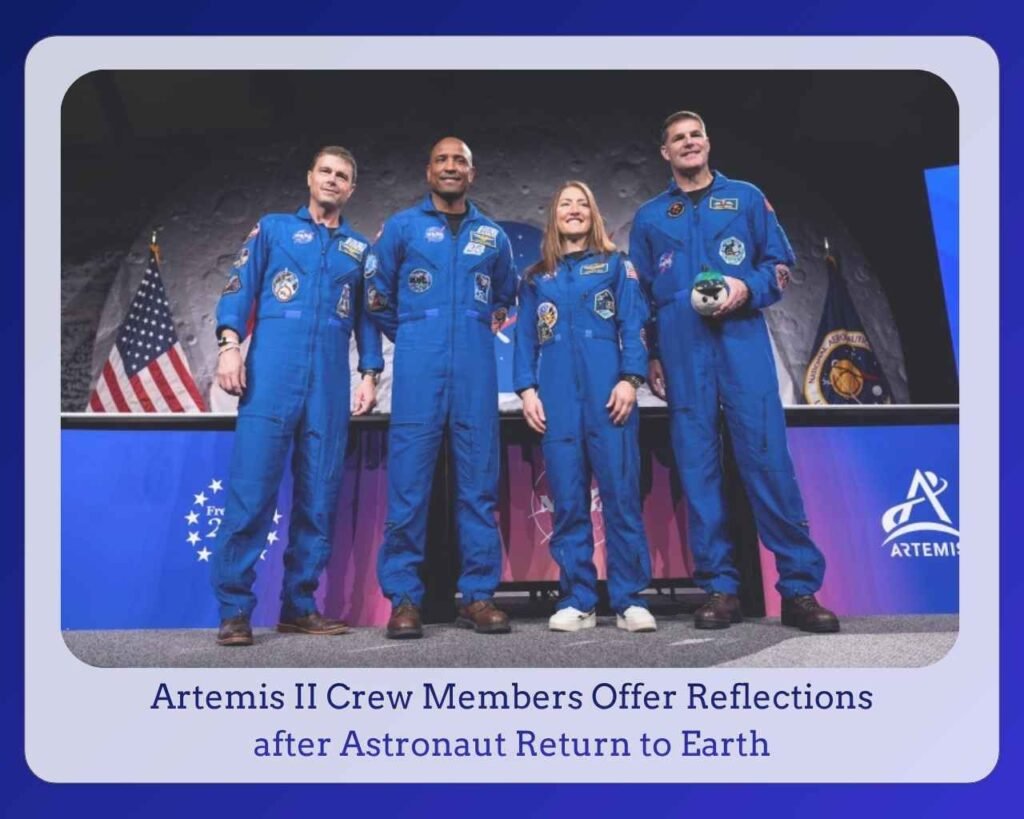
After a perfect splashdown, all four astronauts returned Saturday at Ellington Field in Houston at Johnson Space Center. The team received warm cheers from NASA Administrator Jared Isaacman and other astronauts welcoming them home. Commander Reid Wiseman, Victor Glover, Christina Koch, and Canadian Space Agency astronaut Jeremy Hansen shared some heartfelt thoughts about their journey, which took them almost 252,756 miles away from Earth.
Wiseman started his talk by telling the rest of the crew that their bond will be incomprehensible to anyone outside. “No one down here is ever going to know what the four of us just went through,” he said, adding that it was the best thing that had ever happened to him. As for Wiseman himself, getting 200,000 plus miles away from home made him realize how much he wanted to see his family and friends.
Glover said he felt overwhelmed by gratitude because what they went through and saw out there was something that could not be felt by just one person. Koch offered some insight into crew dynamics when she defined them as people who quietly sacrifice for each other while rowing toward a common goal. Observing that Earth looked so small from the window of Orion made her say, “planet Earth: You are a crew.”
Hansen talked about their “joy train” and explained how they worked hard to find joy in everything despite all the troubles they encountered.
Astronauts Describe Their Hair-Raising Ride During Reentry Into Earth’s Atmosphere

Re-entry was the most dangerous stage of the mission. It consisted of several crucial minutes packed into just 13 minutes. Entering Earth’s atmosphere, the crew was travelling at a speed exceeding Mach 30, and the temperature of their heat shields reached 5,000 degrees Fahrenheit. The intense velocity created a plasma cloud around the capsule and led to a six-minute communications blackout.
Describing the reentry process, Glover called it visceral. “Imagine jumping off a skyscraper backwards. You would feel that way for about five seconds,” he said, describing the moment when the parachutes were deployed and the capsule began to float freely. When he heard the noise of parachutes opening after the communications blackout, he was surprised.
Despite the intensity, Wiseman reported smooth flight conditions. “We came in faster. We came in hot,” he stated, referring to the modified path. He and Glover observed what seemed to be char loss throughout the reentry procedure, moments when pieces of the heat shield detached. After splashing down, the crew inspected the underside of the capsule on the recovery ship, leaning over to look for any signs of damage. They discovered a little bit of char loss at the shoulder of the heat shield.
“For four people simply looking at the heat shield, it looks fantastic to us,” Wiseman noted. Experts will analyze the recovered heat shield’s performance in detail.
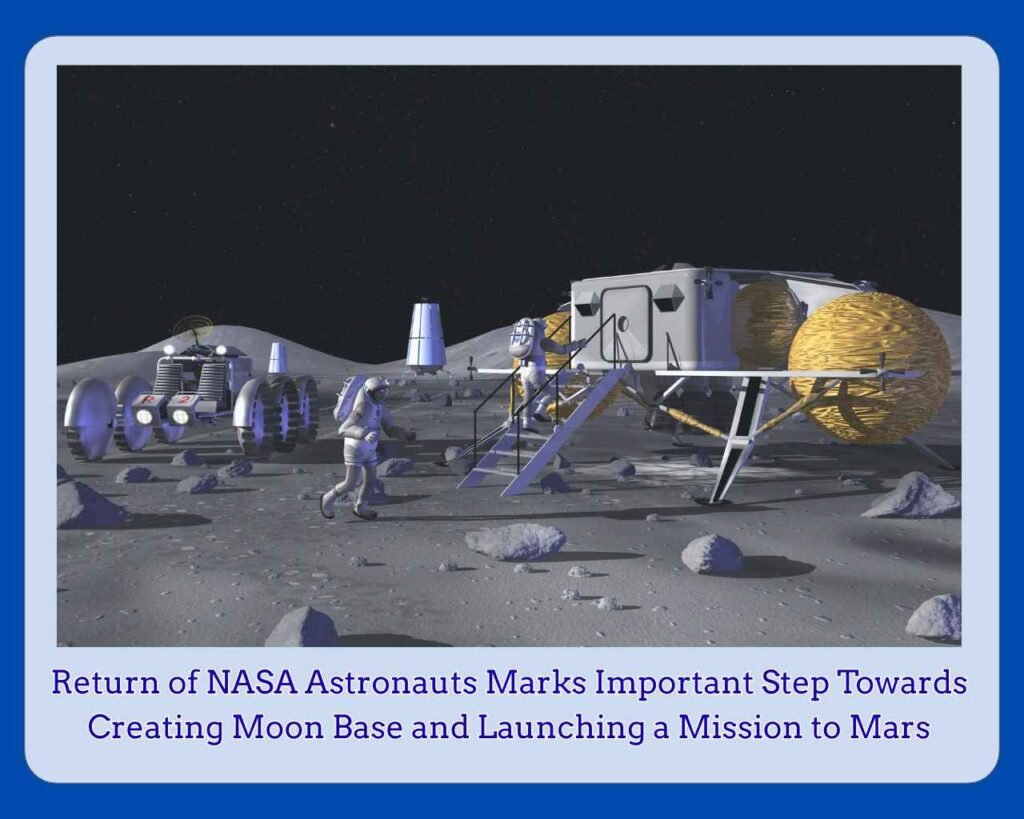
Return of NASA Astronauts Marks Important Step Towards Creating Moon Base and Launching a Mission to Mars
The mission’s scientific significance goes well beyond the return of the astronauts to Earth and gives NASA unique health data gathered during the deep space travel. For the first time since Apollo 17, the crew travelled past Earth’s protective magnetic field and faced increased exposure to radiation. According to Dr. Farhan Asrar, there are still many aspects of the effects of deep space travel on the human body that scientists do not understand.
Several breakthrough experiments turned the crew members into test subjects. The AVATAR experiment used organ-on-a-chip devices filled with bone marrow cells taken from the astronauts of the Artemis II mission. This allowed researchers to study the genetic changes that deep space travel and microgravity caused to astronauts’ bodies. The ARCHeR experiment monitored stress, sleeping habits, and cognitive performance using wristband sensors.
Conclusion
Indeed, the return of the Artemis II crew members is a historic moment in the field of space explorations. Their 10 days long flight allowed gathering crucial information related to exposure to radiation and health effects. Moreover, the astronauts performed an extremely difficult 13-minute descent to Earth. Importantly, the return of this crew sets the stage for establishing a base on the Moon and eventually taking the first humans to Mars.
FAQs
Q1. When did the Artemis II crew return to Earth, and where did they land?
The Artemis II crew landed in the Pacific Ocean off the San Diego coast last Saturday after a 10-day long trip in space. Later that day, they landed at Ellington Field at Johnson Space Center in Houston, Texas.
Q2. How fast did the Orion capsule move when entering Earth’s atmosphere?
The Orion capsule was traveling at a tremendous speed of about 40,000 km/hr or over 30 times the speed of sound. This speed led to reaching the temperature of 5,000 degrees Fahrenheit on the spacecraft’s heat shield. Furthermore, it generated plasma around the craft and a temporary communication blackout that lasted for 6 minutes.
Q3. What health issues do astronauts experience after returning from deep space?
According to the studies, astronauts may lose 1 to 1.5% of bone mass every month spent in space. After returning from their mission, astronauts have to be trained in order to strengthen muscles and restore bone density. In addition, astronauts were exposed to high doses of radiation because they went beyond the protection provided by the Earth’s magnetosphere.
Q4. What scientific experiments did the Artemis II crew conduct?
Among other things, astronauts carried out groundbreaking scientific experiments, including AVATAR, involving use of organ-on-a-chip devices that contained bone marrow cells. Thanks to this experiment, scientists could track changes in genes caused by the effects of deep space radiation and microgravity. Also, the astronauts participated in the ARCHeR experiment analyzing stress and its impact on sleep and cognitive functioning.
Q5. What are NASA’s next steps after the Artemis II mission?
Artemis III will take place in 2027, and the next mission will include landing on the Moon scheduled for 2028. NASA is aiming at establishing a moon base at the price tag of $20 billion, which will be later used to send the first astronauts to mission to Mars in the 2030s.
References and Sources:
- Updates on missions and insights from astronauts come directly from NASA press conferences.
- Reentry speed data and risks posed by deep-space environments to astronauts’ health have been verified by the Aerospace Division of ABC News and planetary science periodicals.
Disclaimer: This information is provided for general informational purposes only by OrbitNewsHub. Even though considerable effort has been made to ensure that the scientific data, mission details, and health facts presented in this article are current and accurate, they are all subject to change as new research findings become available from organizations such as NASA and the Canadian Space Agency.
Read My Website Recent News Article: Tom Trbojevic Hamstring Injury
