


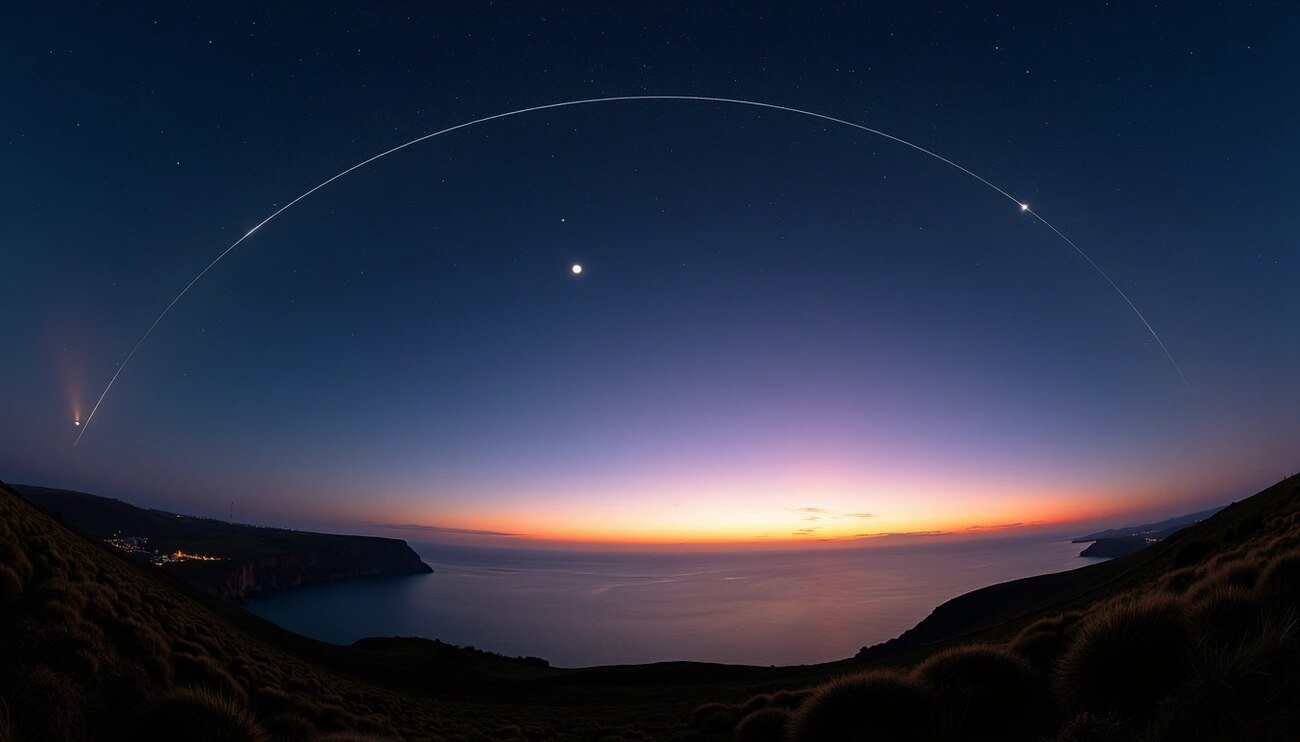
Astrophotographer: A milestone in astrophotography was achieved when award-winning astrophotographer Josh Dury recorded a rare six-planet display covering almost 180 degrees of the sky in the United Kingdom. The rare display of the six planets Mercury, Venus, Jupiter, Saturn, Uranus, and Neptune, which could be viewed from the southern coast of England on 24 February at 18:35 local time, stretched from Jupiter in the southeast to Venus on the left. Josh Dury used professional astrophotography equipment, including a Sigma 15mm diagonal fisheye lens, to record the complete display of the six planets. This is a clear example of how the right telescopic equipment for astrophotography and the right camera settings allow astrophotographers to capture historic moments in the sky.
UK Astrophotographer Records Historic Six-Planet Display Over England
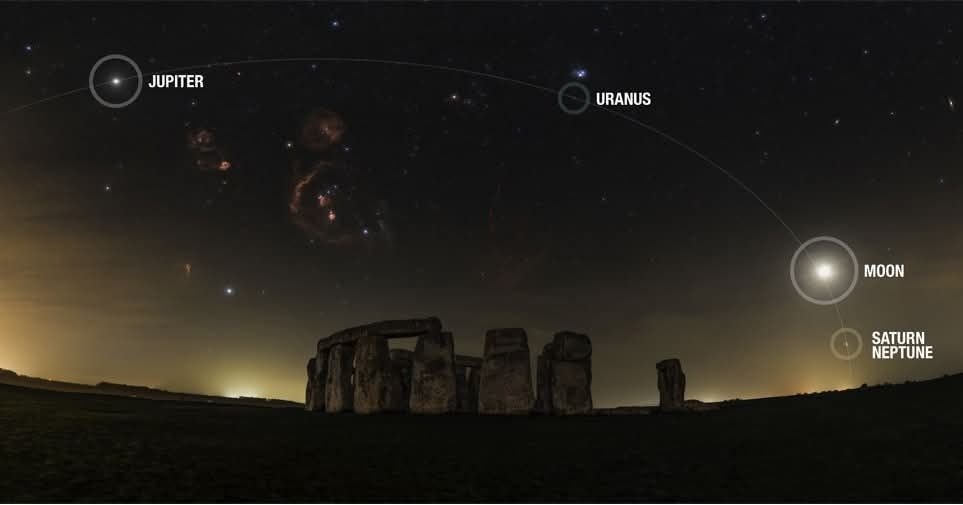
Image Source: Facebook
Josh Dury Records Historic Six-Planet Display
Josh Dury recorded the six-planet display from a radar memorial in Worth Matravers on the South Coast of England on 24 February 2026. The experienced astrophotographer recorded the display of the six planets Mercury, Venus, Jupiter, Saturn, Uranus, and Neptune at 18:25 local time, when he felt the viewing conditions were optimal. Josh Dury had traveled for four hours to reach his location, which took longer because of road closures.
The photographer’s experience with planetary parades was helpful in this shot. Dury had previously recorded a seven-planet alignment in February 2025. This gave him experience with the technical difficulties involved in wide-field astronomical photography. His experience helped him appreciate the importance of the 2026 alignment, even though Mars was not present in this year’s show.
Dury used a fisheye lens to record a nearly 180-degree view of the event. A diffuse filter spread the light from the stars and planets over a larger area, making them easier to distinguish in the photograph. This technical skill enabled him to record the faint outer planets together with the brighter inner planets in a single exposure.
The astrophotographer described the technical requirements of the shot. “Because of the light from the first-quarter moon and the lingering twilight, Venus had to be placed as low in the horizon as possible to record the fainter planets, Uranus and Neptune,” Dury said. His ultra-wide-angle lens recorded Jupiter in the southeast corner and Venus on the left, covering the entire planetary lineup.
Timing and Locations of the Planetary Parade
The planetary parade was most visible on February 28, when the planets were closest together, although the optimal viewing date differed depending on the location. Information gathered from the Star Walk app showed that there were optimal viewing dates for the planetary parade for viewers around the world: February 25 for São Paulo, February 28 for Athens, New York, Mexico City, and Tokyo, and March 1 for Beijing, Berlin, London, and Mumbai. The optimal viewing date was March 2 for Reykjavik.
For viewers in the United Kingdom, the optimal viewing time was about 30 minutes after sunset. The planets had to be in specific positions in order to be visible. Mercury, Venus, Saturn, and Neptune were visible in the western sky near the horizon shortly after sunset. Uranus was higher in the sky in the constellation Taurus and was visible until about midnight, giving viewers ample time to view the parade if they had the proper equipment.
Jupiter was the easiest planet to spot, shining brightly in the constellation Gemini and being visible throughout the night even in areas with light pollution. Saturn was visible with a yellowish glow in the western sky, although it sank lower in the sky as the month progressed.
Mars did not take part in the planetary display of 2026, as it had moved to the dawn side of the Sun and was visible on the opposite side of the planets. This made it impossible for the alignment of all seven planets, which was seen in the previous year’s display. A planetary parade is when several planets line up on one side of the Sun as viewed from Earth.
Weather Conditions and Viewing Possibilities
The weather conditions in the United Kingdom varied during the planetary parade. The forecast for the Friday night display showed that the best viewing conditions would be in Scotland and Northern Ireland, while England would be mostly cloudy with some rain. The forecast for the Saturday night display showed that England and Wales would have the best viewing conditions, but this would be followed by clouding from the north and west. By the Sunday night display, the clear viewing conditions would be restricted to the eastern and southern parts of England.
The success of Dury’s planetary alignment capture on February 24 was made easier by favorable overhead conditions at his coastal location. He described the event as a true delight, with Venus becoming visible shortly after sunset, while Mercury and Saturn could be seen as daylight faded. The Moon and Jupiter were easily visible, while Uranus was visible near the Pleiades (M45) and Neptune lined up near Saturn.
The alignment could still be viewed until February 28 for those in areas with unobstructed western horizons. The ability to find locations with the best views of the horizon was critical, especially for viewing Mercury and Venus, which were very low in the sky. Locations with high elevation elevations were advantageous for capturing the entire planetary alignment.
Mercury, Venus, Saturn, and Jupiter could be viewed with the naked eye under clear skies. Uranus and Neptune required the use of binoculars or a telescope to spot, as these outer planets take the longest paths through the cold outer reaches of our solar system. Even experienced sky gazers would find it difficult to spot the fainter planets without optical aid.
Sky gazers expected Saturday, February 28, to offer the best viewing of the planetary procession. The weather forecast showed cloudy skies during the main event, making Dury’s earlier photograph especially useful as evidence of this rare occurrence. Sky gazers also observed that the observation of six planets in the sky was an unusual, but not very rare, occurrence that happened periodically.
Which Planets Are Visible in the February 2026 Parade?
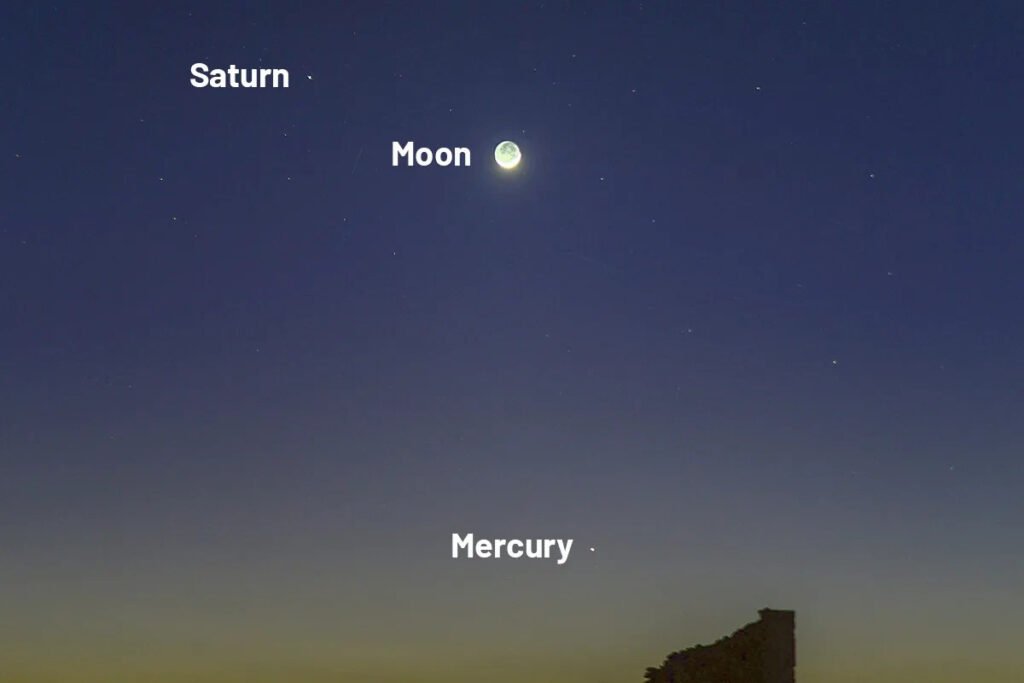
Image Source: BBC Sky at Night Magazine
Six planets lined up for the February 2026 sky show, although their visibility was not equal. Mercury, Venus, Neptune, Saturn, Uranus, and Jupiter lined up in the evening sky shortly after sunset. Four planets could be viewed with the naked eye under clear skies, while the other two needed optical assistance to spot them.
Venus and Mercury Lead the Western Display
Venus and Mercury were positioned closest to the horizon during the sky show, making observation very difficult. Venus was brightest with a magnitude of −3.8, outshining all other planets in the sky show. Mercury was much dimmer with a magnitude of 0.3, much fainter than Venus. Both inner planets had to be timed accurately for observation, as they set below the horizon about an hour after sunset, following the Sun.
Mercury was an interesting planet to observe. Mercury was at its highest point in the sky after sunset on February 19-20, earlier than the parade’s peak alignment. However, on February 28, Mercury was lower in the sky, although this time the balance for observing Venus was more favorable. Optical assistance with binoculars was sometimes required to locate Mercury because of its low position in the sky near the horizon.
Venus was observable for a longer period than Mercury. It appeared as a bright point of light in the western sky. The brightness of Venus made it one of the easiest planets to observe, visible shortly after sunset while twilight was still present. Binoculars were helpful in observing both inner planets, especially when the glow of the recently set sun was still visible in the sky.
Jupiter and Saturn Dominate the Evening Sky
Jupiter was the most visible planet during the parade, with a brightness of magnitude −2.3 in the constellation of Gemini. The gas giant was located high in the southern sky, making it much easier to spot than the other planets, which were located closer to the western horizon. The brightness of Jupiter, which was four times less than the actual brightness of Venus, still made it the dominant object in its part of the sky. The planet remained visible for most of the night, still being accessible even in light-polluted cities.
Saturn was located in the western sky above the planets of Venus and Mercury, with a brightness of magnitude 1. The ringed planet had passed the opposition and was slowly moving towards the solar conjunction, which was scheduled to take place on March 25. The visibility of Saturn in the naked eye gave the observer another object to spot, but its fading brightness indicated that the best time for observation had already passed. The planet was located close to Neptune, with the two being separated by two degrees.
The steady, white light of Jupiter made it easier to spot compared to the twinkling light of the stars. The location of Jupiter in the constellation of Gemini made it much easier to spot compared to the other planets, which were still hampered by horizon problems in the western sky. The yellowish color of Saturn was still visible to the naked eye, especially when scanning the western sky in the fading darkness.
Uranus and Neptune: A Challenge to Naked-Eye Observers
Uranus and Neptune occupy the far-off outer reaches of the solar system, making them much less bright than their inner planet counterparts. On February 28, Uranus had a magnitude of 5.7, making it just below the Pleiades star cluster (M45). Binoculars were sufficient to spot the ice giant planet, although its brightness made it a challenge for amateur astronomers. The planet was located in the constellation of Taurus, roughly equidistant from the group of four western planets and Jupiter in the southern sky.
Neptune, on the other hand, was much more challenging to spot. With a magnitude of 8, it was necessary to use a telescope to spot the planet. An 8-inch (200mm) or larger telescope would have been able to spot the tiny blue planet in the night sky. However, its low horizon location and proximity to the lingering solar glare made it a challenge to spot on the nights surrounding February 28. Even an 8-inch (15cm) telescope would have had difficulty spotting the planet in the twilight sky.
Neptune, by necessity, must be viewed through a telescope because it is never visible to the naked eye under any conditions. Uranus, while theoretically visible to a person with very keen eyesight, is actually quite faint and can only be viewed from dark skies with exact knowledge of its position among other faint stars. In both instances, the use of a telescope is encouraged.
Why Mars Misses This Planetary Showcase
Mars missed the February 2026 planetary show because it was on the opposite side of the sun from Earth. Mars’ absence meant that instead of a possible seven-planetary display, only six planets could be viewed. Mars was on the dawn side of the sun in 2026, meaning that it could not be viewed in the evening sky among the other planets. Mars was on the dawn side of the sun instead of the dusk side, which would have allowed it to be visible in the evening sky.
A triple superior conjunction occurred in mid-January 2026, with Venus, Mars, and Mercury; however, this alignment was not visible from Earth. Venus occurred at superior solar conjunction on January 6, Mars on January 9, and Mercury on January 21. These conjunctions occurred on the opposite side of the solar system, very close to the Sun, where only solar observatories could pick up the three planets in the glare. This explained Mars’ absence from the evening observations until late February.
How Dury Overcame Technical Challenges Spanning 180 Degrees
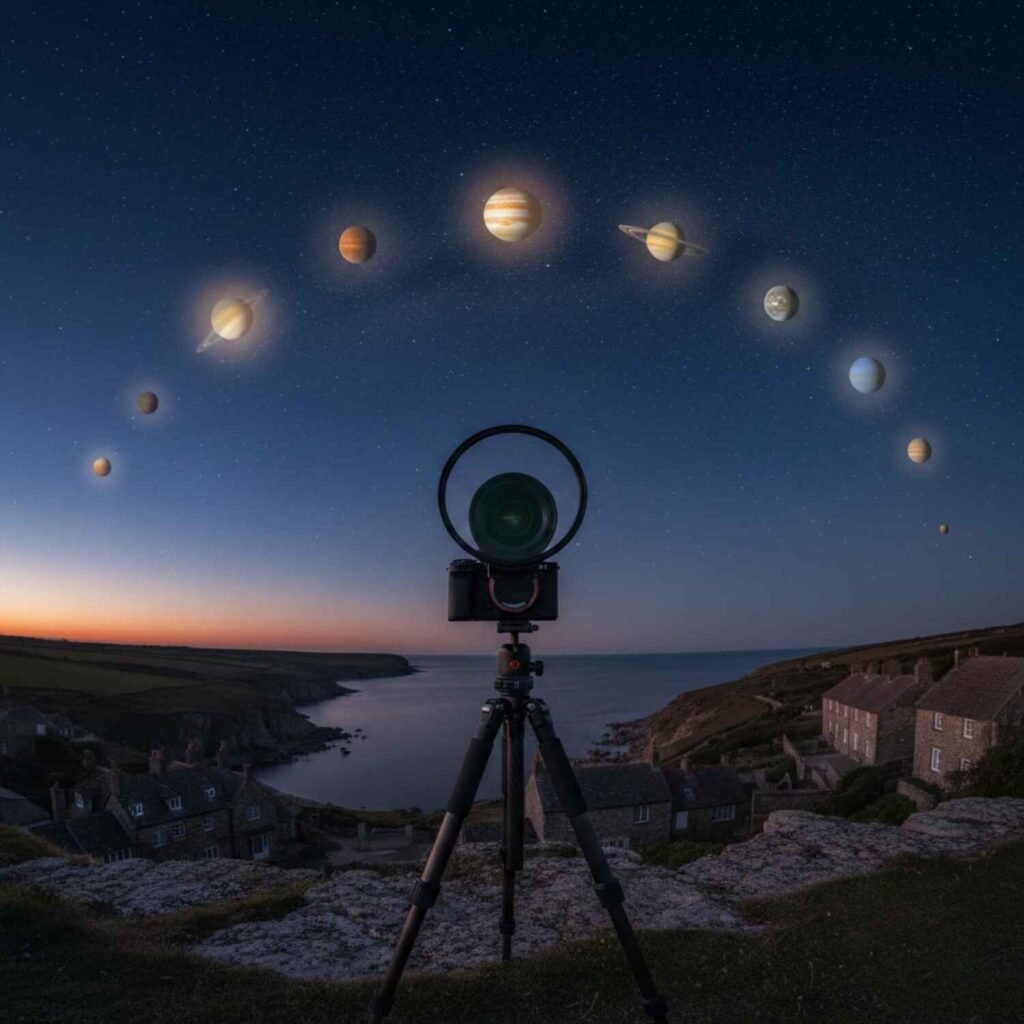
The extent of the planetary lineup posed a challenge to Dury that had never been encountered before. Six planets lined up almost 180 degrees in the sky, which demanded the use of specialized equipment that could capture almost half the sky in a single shot. Normal camera lenses would have forced Dury to choose which part of the alignment he wanted to capture, which would have meant the exclusion of either the eastern or western planets in the final photograph.
Capturing Nearly Half the Sky in a Single Frame
Dury used a Sigma 15mm diagonal fisheye lens to meet the unusual field-of-view requirement. The fisheye lens allowed him to capture Jupiter in the southeast corner at one end of the alignment and Venus to the left, thus covering the entire planetary alignment. The standard wide-angle lens would normally capture an angle of 60 to 100 degrees of the sky, which is not sufficient to cover an alignment of nearly 180 degrees. The fisheye lens caused barrel distortion, where straight lines appeared as curves, but this was a necessary evil to include all six planets in the frame boundaries.
His location on the southern coast of England at 18:35 local time on Tuesday, February 24, provided a clear view from horizon to horizon. His location on the coast ensured that there were no trees, buildings, or other terrestrial objects to obstruct the view of the planetary alignment. This location choice was a necessary complement to the choice of the fisheye lens, as no fisheye lens, no matter how wide, can see around physical obstructions.
Fighting Fading Twilight and Moonlight
As the twilight intensified, the sky was filled with the brightness of lingering daylight, which made it difficult to capture the six-planetary lineup because of the faint light of the planets. The presence of a first-quarter moon did not help much, as it further increased the light intensity. The longer exposure times required to capture the outer planets would have resulted in the overexposure of Venus and Jupiter, which were much brighter.
Dury realized that he had to wait for the light to fade as much as possible to locate the outer planets. The trick was to time his exposure perfectly. If he exposed the sky too early, the light of Neptune and Uranus would be swamped by the sky glow. Waiting too long would cause Mercury and Venus to set below the western horizon.
The shoot required technical expertise. Venus had to be placed as low in the horizon as possible, which required the photographer to capture the image during deeper twilight to allow the light from the weaker outer planets to reach the sensor. It was a more complex timing shot than just pointing and shooting.
Confirming Locations of Fainter Outer Planets
In the final shot, the locations of the fainter outer planets were visible thanks to a NiSi Starsoft diffuse filter. This astrophotography accessory increases the surface brightness of a planet by projecting its light over a slightly larger area on the sensor. It also produces small diffraction spikes around bright objects, making Venus, Jupiter, and Saturn stand out while allowing Uranus and Neptune to be visible enough against the twilight sky.
Without the filter, Neptune at magnitude 8 and Uranus at magnitude 5.7 would have been no more than dots, easily confused with other stars of similar brightness. The Starsoft filter increased their visibility enough for Dury to confirm their location in the shot through test exposures at the location. This was important, as it allowed the photographer to confirm that all six planets were aligned in the shot.
The diffusion filter is based on the intentional use of optical anomalies that distribute both starlight and planet light, but it preserves the sharpness of the image. The pros who photograph the night sky employ these filters when there are objects with vastly different brightness levels in the scene. The aim is straightforward: prevent the faint objects from disappearing while still capturing detail in the brighter ones.
Dury’s approach was all about balancing a number of competing variables: the width of the scene, the length of exposure, the timing of twilight, and how to increase brightness. Each decision affects the others, and it’s a rather tight optimization problem. The Sigma 15mm fisheye lens provided the wide angle needed. The timing had to balance between the fading darkness of twilight and the locations of the planets. The NiSi Starsoft filter was useful in filling the brightness difference between the bright Venus and the fainter Neptune. Taken together, these odds-and-ends enabled scientists to photograph a rare astronomical occurrence that occupied almost half the visible sky.
Essential Equipment for Planetary Astrophotography
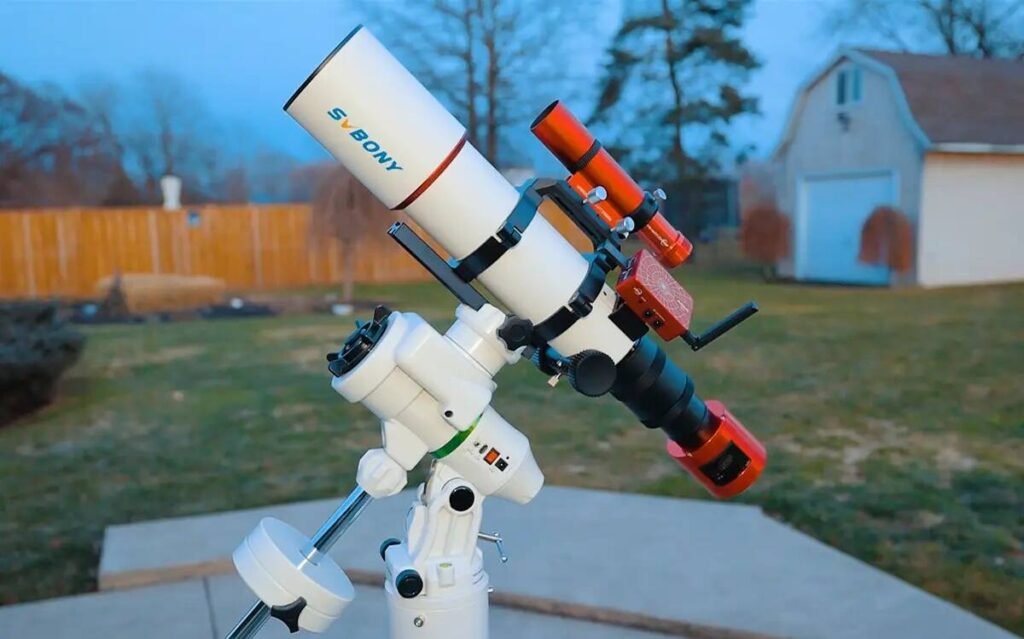
Image Source: AstroBackyard
When you’re on the hunt for planetary alignments, you’re operating under a different set of rules than deep-sky astrophotography. You require equipment that can capture a broad twilight field, accurately target planets, and tease out subtle details in the faint light of a sunset sky.
Selecting the Right Telescope for Planetary Photography
When it comes to serious planetary astrophotography, focal length is the ultimate goal—think at least 2000 mm to image distant planets. The aperture is also important: a minimum of 200 mm (8 inches) is required to resolve planetary surface details and provide sufficient light. A useful guideline is that the aperture should be about one-tenth the focal length. Thus, a 2000 mm focal length system is paired with an 8-inch aperture.
Schmidt-Cassegrain telescopes are a great all-around choice for this purpose. They allow you to pack long focal lengths into a compact tube by using mirrors to multiply the focal length, providing ample planetary magnification without the need for unwieldy optics. For example, the Celestron EdgeHD 9.25 features a 235 mm aperture and 2350 mm focal length, natively at f/10. They are also much lighter than comparable reflector telescopes, reducing the strain on an equatorial mount and making them easier to transport.
Maksutov telescopes provide another alternative, often with higher native focal ratios and excellent contrast. They have smaller secondary mirrors than Schmidt-Cassegrains, making them more efficient at illuminating the details of the Moon and planets. They are ideal for planetary astrophotography, but their highly specialized design makes them less versatile for deep-sky astrophotography.
For high-magnification planetary astrophotography, you will require a robust equatorial mount. Autoguiding systems are useful for compensating for drift and flexure, which become more pronounced with longer exposure times. Ensure that your mount can support more than the total weight of your telescope, camera, and accessories to maintain balance during long astrophotography sessions.
Sigma 15mm Fisheye Lens for Ultra-Wide Skies
The Sigma 15mm f/1.4 DG DN Diagonal Fisheye Art lens offers a staggering 180-degree diagonal field of view that fills the frame. This ultra-wide-angle system allows astrophotographers to record planetary alignments that cover almost half the sky in a single exposure. The lens features 21 glass elements in 15 groups, which helps to account for its hefty 3.0-pound weight.
A rotating tripod collar on the lens barrel facilitates fast leveling for landscape photography and seamless transitions between landscape and portrait formats. The base features Arca-Swiss dovetail cuts, allowing you to directly attach it to compatible tripod heads without the need for release plates, making quick work of setups during short twilight windows.
Manual focus lock eliminates blur during gear movement in low-light conditions. The focus lock feature maintains focus during camera turn-off and turn-on, eliminating the need to re-focus. The lens features a large, textured focus ring for easy manual focus, even when using thick gloves in cold environments.
The lens barrel features mounting points for optional lens heaters to prevent condensation on cold, clear nights during long exposure shots. The front cap features storage pockets for two filters in separate compartments, minimizing the risk of lost filters in the field.
At f/1.4, the lens captures point-star images across the frame without light splitting. The high light transmission is ideal for night and landscape photography, allowing for short exposure times to capture fast-changing aurora displays. It will be available March 7, priced at $1,999.99, in Sony E-mount or L-mount versions.
NiSi Starsoft Filter for Planetary Brightness
The NiSi Starsoft astrophotography filter increases the perceived surface brightness of planets and stars by extending their light emission over a larger area of the sensor. Brighter celestial bodies appear larger in the image due to this diffraction effect, making constellations and planetary formations more dramatic. The filter does not cause any light loss and maintains a neutral color cast.
The Starsoft filter operates in a similar manner to a graduated neutral density filter, where the top 100mm is full strength and the bottom 50mm is clear. This design allows you to place the filter in a manner that enhances star detail without affecting the foreground landscape. However, if you wish to achieve effects throughout the scene, you can slide the filter all the way down in the filter holder.
Field tests were conducted under a full moon outside of the Milky Way’s peak season, and the outcome was clear. Images taken using the Starsoft filter produced stars that were more defined, brighter, and more bold than images taken without the filter, without any distracting effects on the foreground and natural color retention throughout the scene.
Best Camera for Astrophotography Settings
The type of camera to use depends largely on the subject matter you wish to photograph. When it comes to solar system astrophotography, small and fast CMOS sensors are best suited, while larger format monochrome sensors are ideal for deep sky astrophotography. When it comes to nightscapes and Milky Way astrophotography, color DSLR and mirrorless cameras are the best suited.
Planetary cameras provide faster frame rates required for lucky imaging. These specialized cameras for astronomy usually do not come with cooling fans, making them different from deep-sky cameras designed for long exposure photography. Planetary imaging is more like video recording, where you record thousands of images and combine them later to overcome atmospheric distortion.
Any digital camera with manual settings can provide good astrophotography results. The camera brand becomes less important than how well the tools you use work together. Monochrome planetary cameras with filter wheels allow you to create color images by taking pictures through different filters, while color cameras make the process easier.
Choosing the Right Astrophotography Tripod
Equatorial mounts compensate for the Earth’s rotation, which would otherwise produce star trails in long exposure photographs. These mounts are necessary for high magnification planetary photography, which requires accurate tracking. Strain-wave mounts are a relatively new design with low backlash and can be used with or without counterweights.
Star trackers provide portable solutions for compensating starlight drift. They are a common combination with digital cameras for Milky Way landscape photography. For instance, the Sky-Watcher Star Adventurer GTi weighs 8.2 pounds and holds 11 pounds of gear, providing accurate tracking for 5-minute exposures on battery power.
Altazimuth mounts are excellent for rapid visual observations, but for long exposure astrophotography, an equatorial mount is best. The mount is more important than almost anything else; a mount that is temperamental and unreliable can spoil an otherwise excellent night. Small, compact equatorial mounts are fine with small imaging equipment, but a good mount is often the most expensive component of an astrophotography rig.
What Makes This Alignment Different from 2025’s Great Parade?
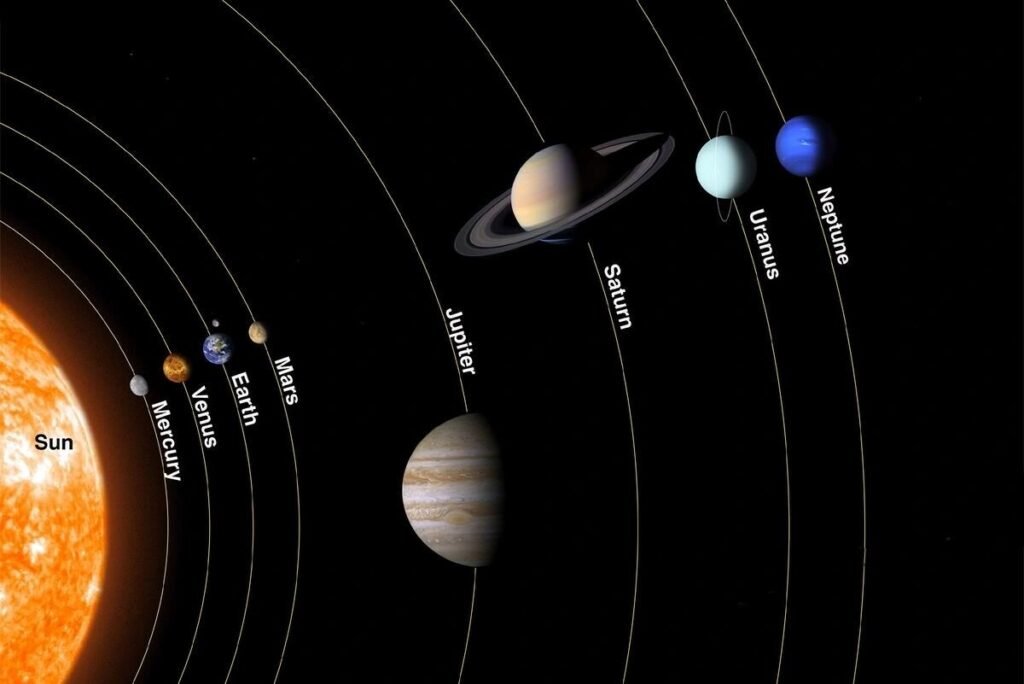
Image Source: News for Kids
The February 2026 photograph brought back memories of a different planetary gathering from the previous year. While this year’s planetary alignment includes six planets, last year’s event provided a fuller house, dubbed the “great planetary parade” by astronomers.
Seven Planets Align in 2025 Skies
On February 28, 2025, sky gazers were treated to a rare treat as seven planets aligned in the evening sky at the same time: Mercury, Venus, Earth’s cousin Mars, Jupiter, Saturn, Uranus, and Neptune packed into the same general area of the sky, creating what astronomers termed a “great alignment.” This occurred because all the planets aligned on the same side of the Sun.
This 2025 occurrence was special even among unusual planetary alignments. Alignments of this magnitude do not occur frequently; a complete seven-planet show is a special astronomical event. During the period of January and February 2025, observation periods lasted longer than usual: except for Mercury, all planets were visible in the evening for several weeks. Saturn, Venus, Neptune, Uranus, Jupiter, and Mars appeared in the evening sky, although late February offered more challenging viewing.
Usually, multi-planet observations last for several weeks, sometimes a month or more, and not just for a night. The planets are too slow-moving to offer spectacular overnight changes in their positions. The 2025 great parade remained visible for several weeks, allowing amateur sky observers and photographers several opportunities to observe the alignment.
Mars Moves to the Dawn Side of the Sun in 2026
In 2026, Mars has moved to the dawn side of the Sun and participates in dawn sky observations rather than evening observations. This shift removes Mars from the 2026 parade, making the list six visible planets instead of seven. In February 2026, Mars is on the opposite side of the solar system, rising with the Sun’s glare making it impossible to observe in the evening.
It is the absence of the planet that distinguishes the two February alignments in a very fundamental way. To be frank, alignments involving six planets are much more common than those involving seven. The 2025 alignment was more rare in that it placed all the naked-eye planets visible from Earth at the same time. In the future, Mars will return to the evening sky while the orbital cycles of the other planets maintain their rhythmic dance around the Sun.
How to Catch the Remaining Days of the Planetary Parade
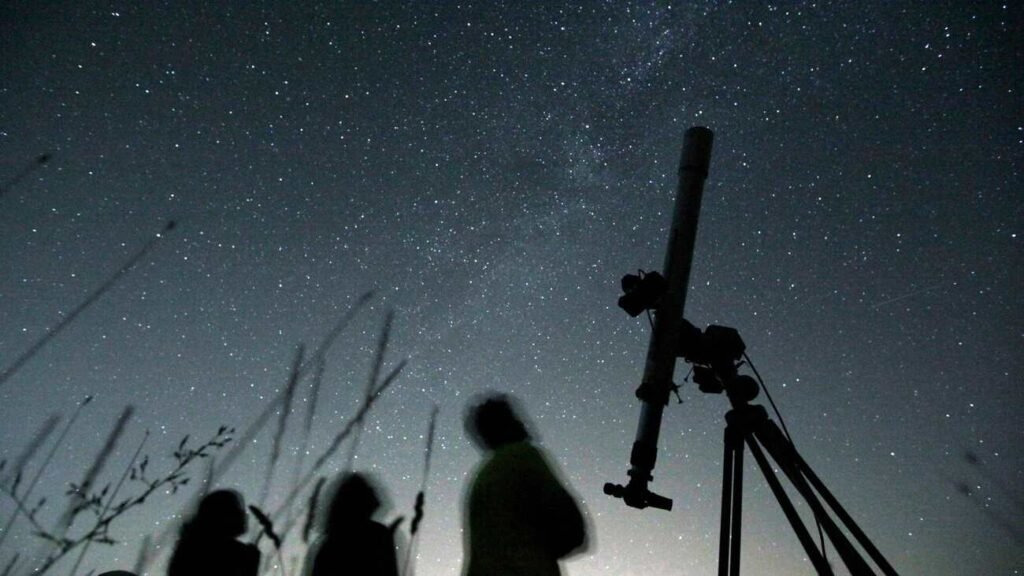
Image Source: NewsNation
You can still view the planetary parade through February 28, with opportunities to view the lingering presence of the parade a few days after the optimal planetary alignment. These planetary alignments occur over a period of weeks rather than a single night, as the planets are slow enough in their orbits that extreme changes from night to night are not likely.
Best Times to View Through February 28
Begin scanning the sky 30 minutes after sunset in your local time zone. This provides the optimal opportunity to spot at least three planets in the sky at one time, as Saturn, Mercury, and Venus set in the west shortly after the Sun. The viewing period will last about 45 minutes until the western planets disappear below the horizon. Thus, a flat, unobstructed horizon in the west-southwest area is essential.
What Beginners Need for Astrophotography
Smartphone stargazing apps are useful for locating planets in your vicinity. Star Walk 2 Plus includes augmented reality functionality that superimposes planet locations on actual sky images. Binoculars are a huge improvement over naked-eye observations, particularly when searching for Mercury and Saturn close to the horizon. Even planets observable with the naked eye can be improved with optical assistance.
Using Binoculars and Telescopes for Astrophotography
Binoculars with a 50mm aperture collect sufficient light for nighttime observations. The 7×50 configuration also offers optimal light transmission with an exit pupil that matches a fully dilated pupil. Supporting the binoculars with a tripod eliminates the strain of holding them and significantly improves the viewing experience. A telescope with 30x magnification power shows Saturn’s rings as two thin bright lines crossing the planet’s surface.
iPhone Astrophotography Tips for Mobile Observers
The iPhone 11 and later models have a night mode feature for longer exposure. If you want more control over your exposure, you can use apps such as ProCam to adjust focus and capture RAW images, which is useful for astrophotography. You can use a tripod or a stable mount to keep your image sharp during long exposure, and a timer helps you avoid shake from pressing the shutter button. When you edit your photos, adjusting exposure, brightness, and contrast can help sharpen your image without pushing colors to oversaturation.
Conclusion
Josh Dury’s documentation of the six-planet parade is a significant milestone in astrophotography, demonstrating how the right equipment and perfect timing make it possible to capture rare celestial events. The 180-degree range from Jupiter to Venus required technical know-how in the form of fisheye lenses and diffusion filters to overcome the interference of twilight. The absence of Mars made this parade different from the 2025 spectacle of the complete seven-planet alignment, although six-planet alignments provide excellent viewing opportunities. With basic equipment, observers can view these planetary parades by following good timing and selecting locations with clear horizons. These planetary parades demonstrate to sky observers that rare celestial events are possible for committed photographers and amateur astronomers.
FAQs
Q1. What kind of equipment did Josh Dury employ to take the photos of the six-planet parade?
Josh employed a Sigma 15mm diagonal fisheye lens to capture almost 180 degrees of the sky and a NiSi Starsoft diffuse filter to increase the brightness of the less bright planets like Uranus and Neptune by illuminating a larger area of the sensor. This allowed him to take all six planets in one shot.
Q2. Which planets were visible in the planetary parade in February 2026?
The planetary parade included the following planets: Mercury, Venus, Jupiter, Saturn, Uranus, and Neptune. The brightest planets visible to the naked eye were Venus and Jupiter, while Saturn and Mercury could be viewed without any optical aid but were harder to spot due to their proximity to the horizon. Uranus was visible with the aid of binoculars, and Neptune was visible with the help of a telescope due to its brightness of 8.
Q3. Why was Mars not part of the 2026 planetary lineup?
Mars was not part of the show because it was on the other side of the Sun from Earth, appearing in the morning sky. This made it impossible for Mars to appear in the evening sky lineup of the seven planets, reducing the lineup in February 2025 to six planets.
Q4. At what time was the best viewing time for the parade?
The best viewing time was about 30 minutes after sunset until February 28, 2026, with a 45-minute window before the planets of Mercury, Venus, and Saturn dipped below the horizon in the west. The best viewing time was on February 28, when the planets were packed most closely together, although the best viewing times varied slightly depending on the location.
Q5. Why is a fisheye lens necessary for wide planetary parades?
A fisheye lens provides an ultra-wide-angle view of nearly 180 degrees, which is necessary for capturing a parade that stretches almost halfway across the sky. Standard wide-angle lenses only provide about 60 to 100 degrees of coverage, making it necessary for photographers to decide which part of the lineup to capture. The Sigma 15mm fisheye lens allowed Dury to capture all six planets, ranging from Jupiter in the southeast to Venus in the west, in a single frame.
Read My Website Recent News Article: Lions Premiership Defense
