


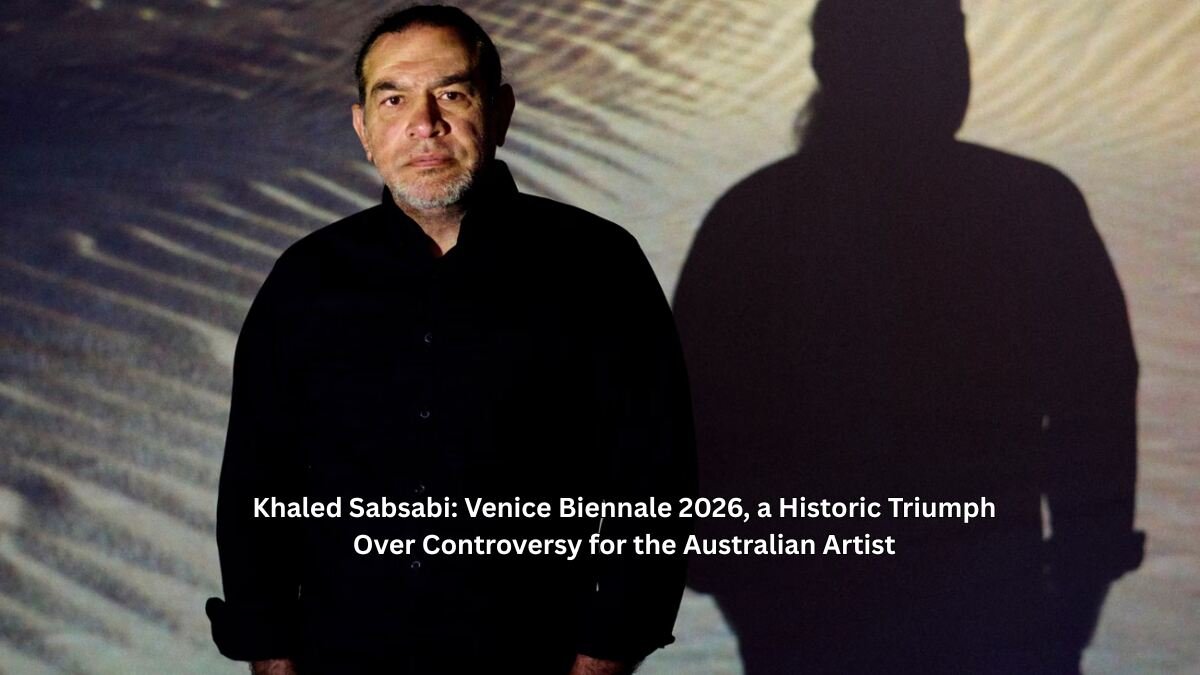
Khaled Sabsabi: In what has been hailed as a historic victory for artistic freedom and cultural resilience, Khaled Sabsabi has been officially named to represent Australia at the 2026 Venice Biennale. However, his journey to being part of one of the world’s most prestigious art events was anything but easy; it was a high-stakes battle against censorship that threatened to silence one of Australia’s most profound artistic voices through bureaucratic fear.
The story of Sabsabi’s involvement goes beyond the world of art to the world of politics, identity, and the determination to maintain one’s artistic history.
The Censorship Controversy That Shook the Art World
The story began in late 2025 when Creative Australia (the government agency charged with arts funding and advisory services) surprisingly chose to withdraw their support for Sabsabi. The reason? A “risk assessment” related to a piece he created more than two decades ago.
The work in question, a 2003 video installation called Mush, included a brief image of a Hezbollah leader. Although the work had been shown internationally for years without any problems, the general geopolitical atmosphere led to fears of a public relations backlash. This “pre-emptive strike” against the artist sparked an immediate and passionate debate about whether government agencies should have the power to “sanitize” the artists they support in order to represent the country.
The Backlash and the Power of the Artistic Community
The move to end the relationship with Sabsabi did not pass without challenge. Within days, the art community in Australia rallied around the artist. More than 1,000 curators, artists, and human rights activists signed an open letter protesting the move as a “chilling precedent” for freedom of expression.
Legal advisors and arts groups suggested that sanctioning an artist for a twenty-year-old piece, which was clearly intended to explore the nuances of conflict rather than celebrate it, represented a profound misunderstanding of the function of contemporary art. Facing the threat of legal action and a serious blow to their international reputation, Creative Australia was forced to issue a rare and public about-face.
Reinstatement: A New Chapter for the 2026 Venice Biennale
After much negotiation and public outcry, Khaled Sabsabi was finally reinstated. In a statement, Creative Australia recognized the “distress” that had been caused to the artist and reiterated their support for his vision.
This reinstatement is more than a correction; it is a momentous occasion. Sabsabi is now on the cusp of becoming the first Australian artist to show two different major works at two different official venues at the Biennale, solidifying his position as one of the titans of Australian contemporary art.
Two Works, Two Venues: A Vision of Spirituality and Borders
The 2026 Venice Biennale is set to be Sabsabi’s most ambitious project to date. His work has always straddled the divide between Western and Eastern philosophies, often reflecting his own Lebanese-Australian experience.
- The Australian Pavilion: Here, Sabsabi will show a site-specific installation that explores the idea of “belonging” in a broken world.
- The International Exhibition: In a unique honor, he will also show a secondary work that examines Sufi mysticism and the invisible borders that exist in the human experience.
Why This Matters for the Future of Australian Culture
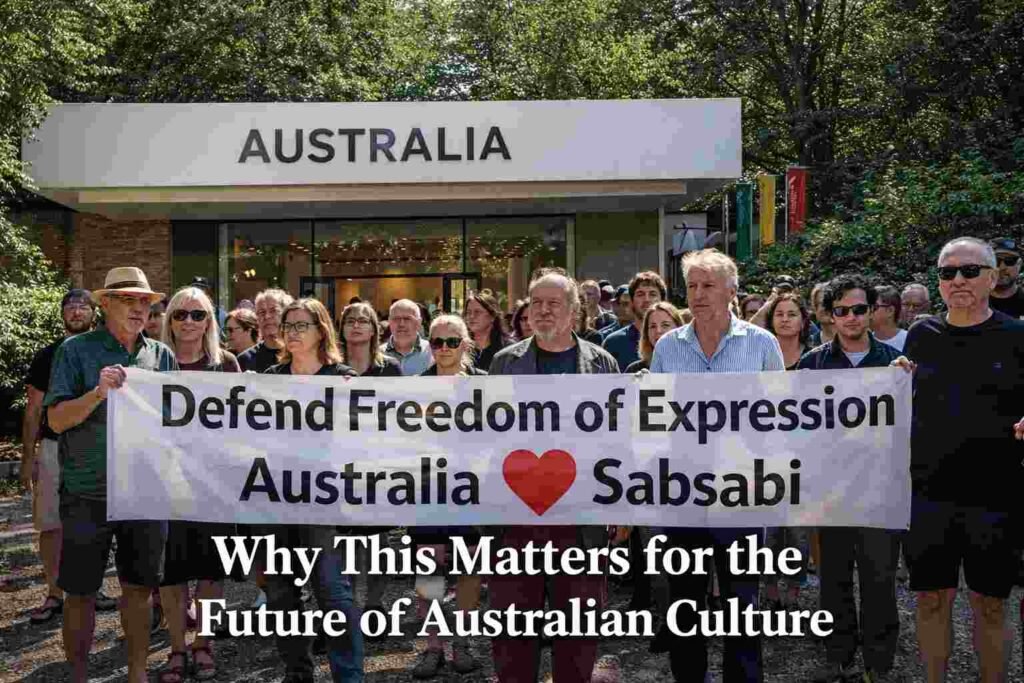
The Khaled Sabsabi saga is a reminder that art is often at its most potent when it is uncomfortable. For the entertainment and arts industry, this is a victory that shows that the industry is not going to stand by and allow political fear-mongering to decide who gets to tell the stories of Australia on the world stage.
With the Venice Biennale 2026 just around the corner, all eyes will be on Sabsabi. However, he is not just representing his art in Italy; he is also representing a message of resilience that shows that true art cannot be simply erased or edited out for the sake of convenience.
Conclusion: A Victory for Artistic Integrity
The Khaled Sabsabi and the Venice Biennale 2026 is a reminder that art remains a crucial front line for ideas. By fighting off the first attempt at censorship, Sabsabi has not only ensured that he gets to show his art at an exhibition; he has also ensured that the importance of historical context is not lost in a world that is all too quick to judge based on sound bites.
Frequently Asked Questions (FAQs)
Who is Khaled Sabsabi, and why is he famous?
Khaled Sabsabi is a very renowned Lebanese-born Australian contemporary artist. He is famous for his multidisciplinary practice, which includes video installation and photography, often focusing on spirituality, conflict, and the experience of migration. He has received several prestigious awards, including the 60th Blake Prize.
Why was Khaled Sabsabi initially removed from the 2026 Venice Biennale?
He was temporarily removed by Creative Australia because of a “risk assessment” related to a 2003 artwork called Mush. The artwork included an image of a Hezbollah leader, which was believed to potentially cause political controversy in the prevailing global scenario.
How was the decision to drop the artist reversed?
Following a huge outcry from the global art community, including an open letter signed by over 1,000 professionals, Creative Australia reinstated him. The art community claimed that removing him was a form of censorship that impeded artistic freedom.
What is special about Sabsabi’s participation in the 2026 Biennale?
For the very first time in history, Khaled Sabsabi will be the first Australian artist to showcase two significant and different artworks at the Biennale. One will be displayed at the official Australian Pavilion, while another has been invited to the Curated International Exhibition.
What kind of themes are explored in Khaled Sabsabi’s artworks?
His artworks are deeply embedded in Sufi mysticism, identity, and the physical and spiritual boundaries that separate people. He often tries to fill the gap between his Middle Eastern background and his life in Western Sydney.
When and where does the Venice Biennale 2026 take place?
The Venice Biennale is a globally celebrated contemporary art fair that takes place every two years in Venice, Italy. The Venice Biennale 2026 will take place from April to November, with millions of visitors expected to attend from all over the world.
Read My Website Recent News Article: Montech NX600 ARGB Review
