


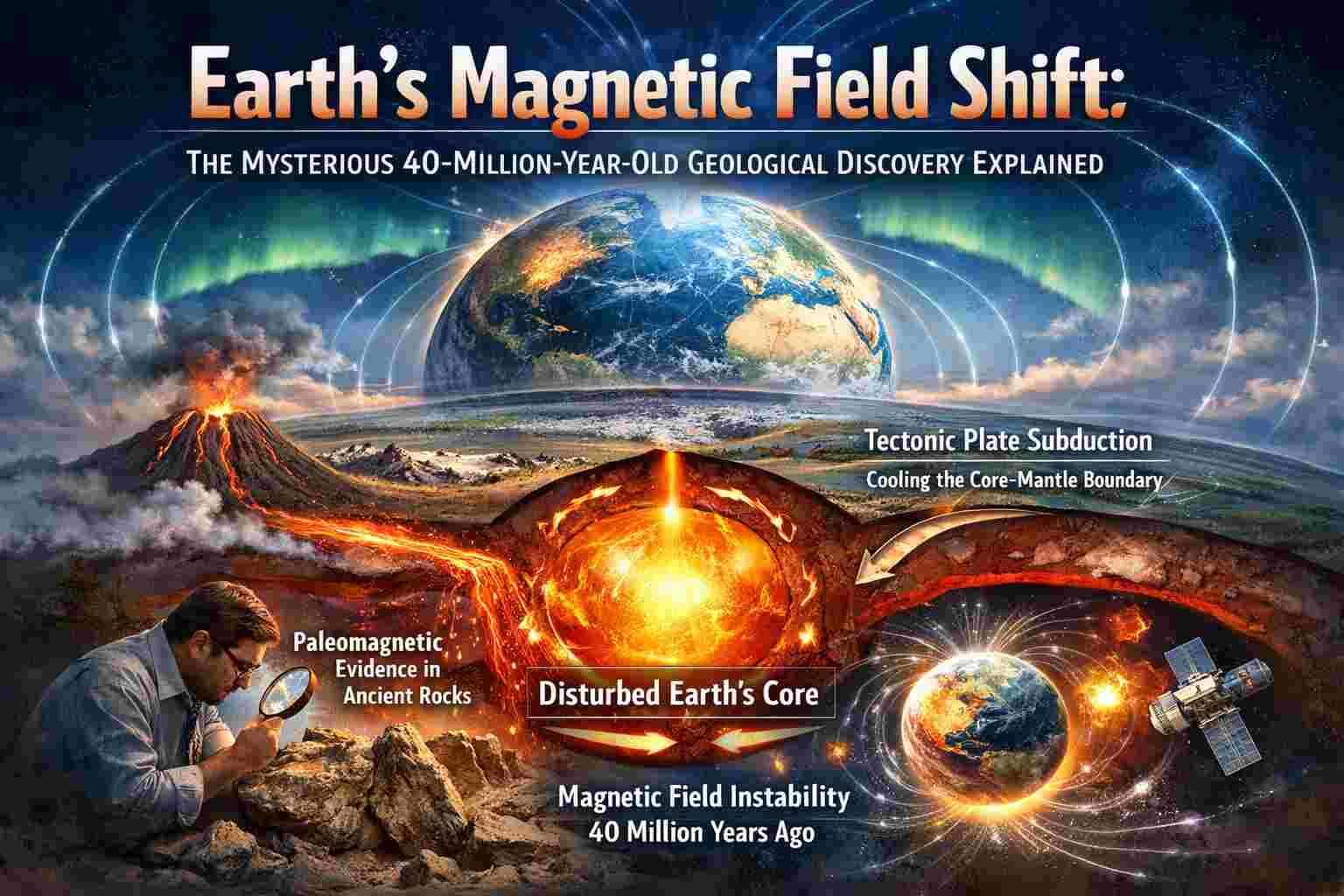
Earth’s Magnetic Field Shift: For decades, scientists have looked at the Earth’s core as a steady, albeit invisible, engine that keeps our planet habitable. However, recent research into paleomagnetism has revealed a startling anomaly: roughly 40 million years ago, something “strange” altered the Earth’s magnetic field. This discovery is forcing geologists to rethink how our planet’s internal dynamo operates and what it means for the future of our global shield.
What Happened to the Earth’s Magnetic Field 40 Million Years Ago?
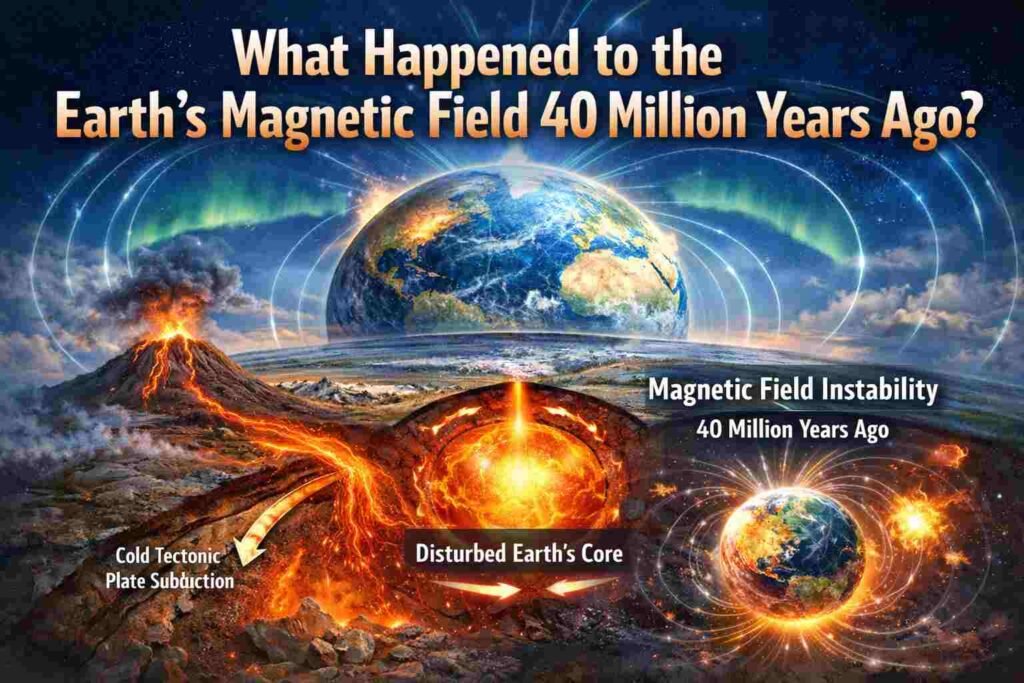
During the late Eocene epoch, approximately 40 million years ago, the Earth was a world in transition. While we knew the climate was shifting, we didn’t realize that deep beneath our feet, the Earth’s magnetic field was undergoing a peculiar transformation.
Researchers studying ancient rock samples—which act as “time capsules” by freezing the magnetic orientation of the era—discovered that the field’s intensity and stability fluctuated in ways that don’t align with standard models. This occurrence was not a typical reversal of the Earth’s magnetic field, where the magnetic poles reverse, but rather a time of high instability, suggesting a major disturbance in the geodynamo, the process by which the liquid iron in the outer core creates the Earth’s magnetic field.
The Science of Paleomagnetism: Unraveling Ancient Magnetic Field Changes
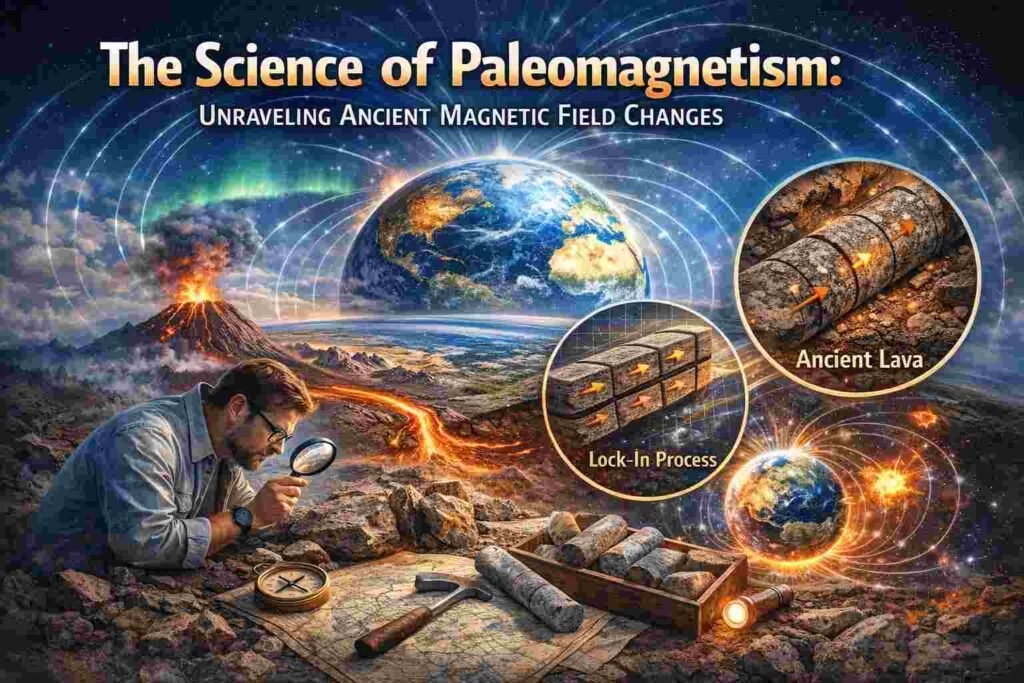
To understand what occurred on Earth millions of years ago, paleomagnetism is used. When lava cools and solidifies, minerals in the lava align in response to the Earth’s magnetic field. By analyzing the age of these rocks and their magnetic properties, ancient magnetic field changes can be inferred.
The Importance of Tectonic Plate Subduction
The most popular theory for this 40-million-year-old mystery involves plate tectonics. It is suggested that the subduction of the Izanagi plate under the East Asian margin was a major factor. As massive plates of the Earth’s crust sink into the Earth’s mantle, they will eventually reach the boundary between the core and the mantle.
Core-Mantle Boundary Disturbances
As these cold tectonic plates meet the hot outer core, they act as a “heat sink,” cooling off the core and disturbing the flow of liquid iron. This disturbance is thought to have caused the unusual change in the Earth’s magnetic field, as the internal convection in the core was disrupted.
Why This Ancient Discovery Matters Today
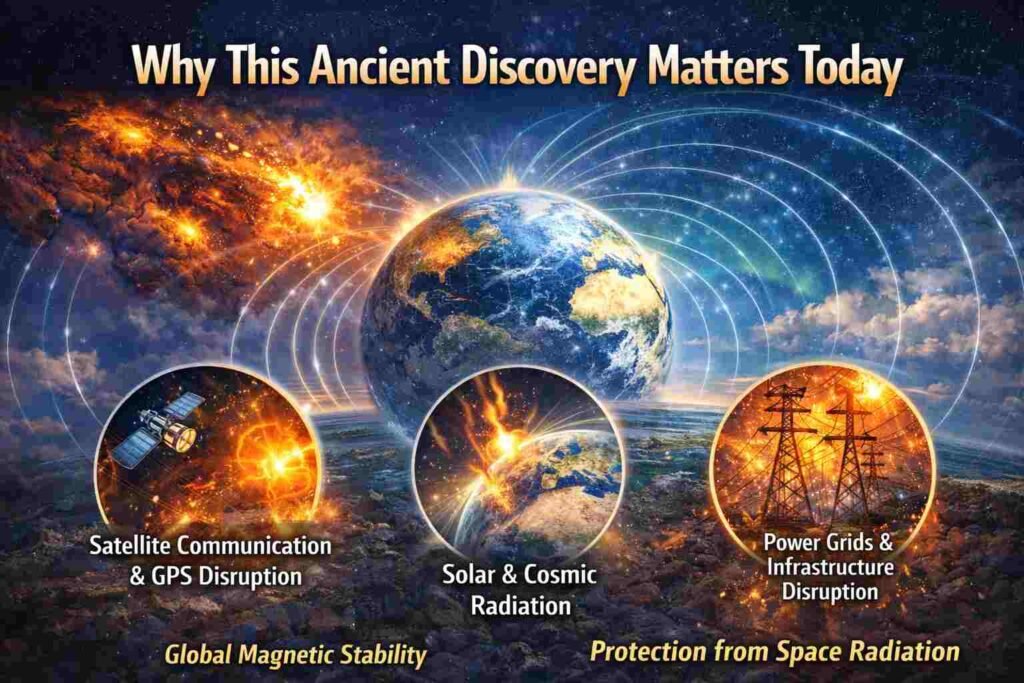
One might wonder why a discovery that occurred 40 million years ago is still widely discussed in scientific circles. The answer is simple: the current magnetic field is decreasing in strength. By studying the anomalies of the past, scientists can gain a better understanding of whether we are moving towards a new magnetic field reversal or a time of great turmoil.
Protection from Solar Radiation
The magnetic field is the first line of defense against solar winds and cosmic radiation. Without it, the atmosphere would be stripped away, and satellite communications would become obsolete. A deeper understanding of how tectonic activity affects the core of the Earth provides a clearer understanding of the planet’s so-called “life support system.”
Key Findings from the Study
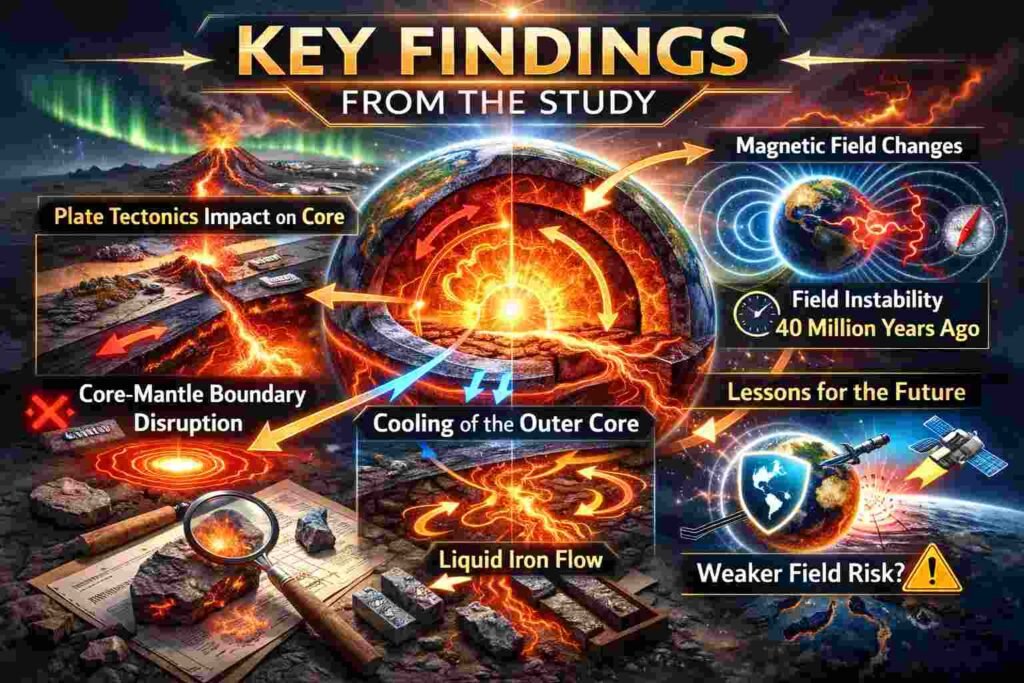
- The Significance: The study clearly shows that surface plate tectonics have a direct and major effect on the deep-core magnetic engine.
- The Anomaly: There was a major period of magnetic field instability 40 million years ago.
- The Reason: Massive tectonic plate motion that cooled the core-mantle boundary.
- The Approach: Paleomagnetic evidence from ancient volcanic rocks was employed to confirm the change.
Final Thoughts for Science Lovers
This finding is a reminder that our planet is a unique and interrelated whole. What happens on the surface will eventually migrate to a depth sufficient to alter the very magnetic shield that protects us. As we watch the South Atlantic Anomaly and other current magnetic changes, the message from 40 million years ago has never been more important.
Conclusion: A New Chapter in Earth’s Geological History
The finding that the magnetic field of our planet underwent a major change 40 million years ago is a strong reminder that our planet is a living, breathing entity. For many years, we considered the deep core and the surface crust of our planet to be two separate things. This study proves that the “slow dance” of tectonic plates can extend thousands of miles to affect the very magnetic shield that protects us from space radiation.
As we continue to observe modern-day fluctuations in the magnetic North Pole, looking back at these ancient anomalies provides a vital roadmap. It helps scientists understand that “strange” isn’t necessarily “catastrophic”—it’s simply how a dynamic planet maintains its balance over millions of years. This geological discovery doesn’t just rewrite history; it helps us prepare for the future of our global magnetic defense.
Frequently Asked Questions (FAQs)
What actually occurred in the Earth’s magnetic field 40 million years ago?
The team discovered that there was a period of instability where the magnetic field strength and orientation changed erratically. This was not a typical reversal or flip but a disturbance that occurred when cold tectonic plates sank to a depth that would “chill” the outer core of the Earth, disrupting the movement of liquid iron.
Is the Earth’s magnetic field changing now?
Yes, the magnetic field is always changing. Today, the magnetic North Pole is migrating from the Canadian Arctic to Siberia at a rate of 34 miles (55 kilometers) per year. Although this is much faster than in the past, it is a natural process, according to scientists.
How do scientists study events from 40 million years ago?
Geologists use a field called paleomagnetism. They study ancient volcanic rocks that contain iron-rich minerals. When these rocks were molten lava, their minerals aligned with the Earth’s magnetic field like tiny compass needles. Once the lava cooled and hardened, that magnetic “signature” was locked in place forever, allowing us to read it today.
Could a magnetic field shift cause a mass extinction?
While a weakening magnetic field allows more solar radiation to reach the Earth, there is no strong evidence in the fossil record that past magnetic shifts or reversals caused mass extinctions. However, a major shift today would significantly disrupt our global satellite networks, GPS, and power grids.
Why is this research considered a “breakthrough” in science news today?
This research is a breakthrough because it successfully links plate tectonics (surface movement) to the geodynamo (core movement). It provides the “missing link” in understanding how the cooling of the Earth’s interior is managed by the movement of the continents above.
Read My Website Recent New Article: St Kilda vs Gold Coast Suns AFL 2026
