


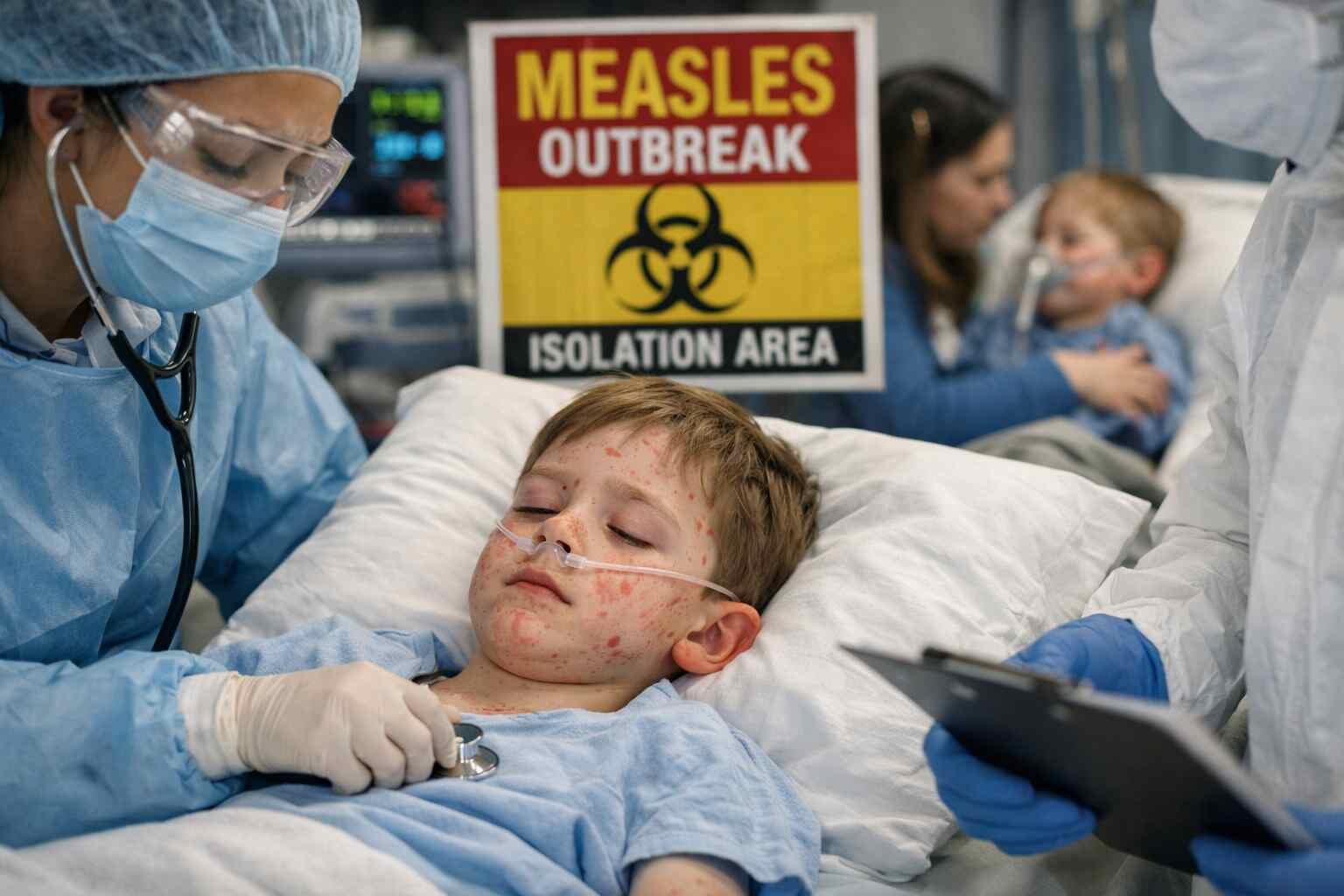
Measles Outbreak in North London: Health authorities in the United Kingdom have issued an urgent warning following a significant measles outbreak in North London. More than 60 children have been confirmed to be infected in a cluster that has primarily targeted schools and nurseries in the Enfield and Haringey areas.
The surge in cases has reignited fears over the declining rates of the MMR (Measles, Mumps, and Rubella) vaccine across the capital, leading to what experts describe as a “preventable public health crisis.”
The Scale of the North London Outbreak
The outbreak was identified at the beginning of February 2026, with a sudden increase in symptomatic children visiting their GPs. The UK Health Security Agency has confirmed that the virus has infected at least seven schools and one nursery school in the London borough of Enfield.
According to medical reports, one in five infected children has had to be hospitalized because of severe complications. Most of the infected children who had to be hospitalized were those who had not received any of the MMR vaccination. Dudu Sher-Arami, Director of Public Health for Enfield, has said that the outbreak is a serious threat to the London area because of the highly contagious nature of the virus.
Why Measles is Surging in London
According to health experts, the “dangerously low” vaccination rates of children are the major reason for the resurgence of measles. For a community to achieve “herd immunity” to measles, at least 95% of the people need to be vaccinated. However, statistics reveal that the vaccination rates of five-year-old children in London are less than 80%.
Key Factors Contributing to the Spread:
- Vaccine Hesitancy: The spread of misinformation on social media among parents regarding the administration of the measles vaccine is a growing concern.
- Post-Pandemic Backlog: The disruption in the administration of medical services during the pandemic resulted in a backlog in the immunization program among children.
- High Contagion Rate: Measles is one of the most contagious diseases in the world, with a single case capable of infecting up to 18 unvaccinated individuals.
UK Loses Its “Measles-Free” Status
This latest outbreak comes on the heels of the formal declaration by the World Health Organization (WHO) last month that the UK is no longer “measles free.” The UK had earned the distinction between 2021 and 2023, but the steady increase in cases over the last two years forced health organizations to reclassify the nation.
In 2024, the nation recorded over 3,600 cases, and the number rose to nearly 1,000 lab-confirmed cases in 2025. The latest outbreak in North London in 2026 is being monitored and may be the catalyst for a “pan-London” outbreak if not addressed immediately.
Symptoms and Advice for Parents
The NHS is asking parents to be aware of their children’s immunization status by referring to their children’s “Red Book.” Measles is not just a mild rash. Its complications can include life-altering conditions such as:
- Pneumonia (the most common cause of measles-related death in children)
- Encephalitis (swelling of the brain)
- Permanent hearing loss
What to Look For
Measles symptoms include cold-like symptoms with high fever, sore eyes, and cough. The rash is blotchy red-brown in color, appearing first on the face or back of the ears.
The authorities advise parents whose children show symptoms of the disease to call their GP or NHS 111 before visiting the clinic to avoid infecting other vulnerable patients.
Urgent Vaccination Drive Launched
The government is planning to launch a vaccination drive throughout the country next week in response to the crisis in North London. The government is setting up temporary clinics in schools in Enfield and Haringey to provide “catch-up” vaccinations to school students.
“It is never too late to get protected,” declared a spokesperson from the UKHSA. “The MMR vaccine is safe, effective, and provides lifelong protection against a disease that can be devastating.”
Conclusion: A Collective Responsibility for Public Health
The current outbreak of measles in North London is a sobering reminder that high vaccination rates are the only defense we have against the resurgence of serious childhood diseases. While medical professionals are working around the clock to combat the effects of the virus, the long-term answer to the problem is community immunity. As the UK officially loses its “measles-free” designation in early 2026, the time to act is now.
The health and well-being of our children are not only the responsibility of our parents but also a collective responsibility. By making sure our families are fully immunized, we are protecting not only our children but also the children who cannot receive the vaccination, such as babies who are not yet old enough and the immunocompromised in our society. The message from health officials is clear: check your records, book your appointments, and stop the spread before it gets to the rest of the city.
Frequently Asked Questions (FAQs)
Q1: How many children have been infected in the North London outbreak?
So far, more than 60 children have been identified as infected in the North London outbreak. The majority of these children are in the Enfield and Haringey areas, with at least seven schools and a nursery being affected.
Q2: Why did the UK lose its measles-free status in 2026?
The World Health Organization (WHO) removed the UK’s measles-free status on January 26, 2026. The UK lost its measles-free status as a consequence of a sustained rise in measles cases over the last two years (2024-2025), coupled with a significant drop in the uptake of the MMR vaccine, which was well below the recommended 95% rate needed to produce herd immunity.
Q3: What is the new MMRV vaccine being introduced in 2026?
The NHS introduced a new vaccine in its routine immunization program on January 1, 2026. The new vaccine, known as the MMRV vaccine, protects against measles, mumps, rubella, and varicella (chickenpox) in children. The first dose of the combined vaccine is given at the age of 12 months, while the second dose is given at the age of 18 months.
Q4: My child has a high fever with a rash. What do I do?
If you believe your child has measles, do not visit your GP surgery or go to the Accident and Emergency Department. The measles virus is highly contagious. Call NHS 111 or your GP surgery. They will probably arrange to visit your child at home to assess their condition without putting others at risk of infection.
Q5: Can adults or older children get vaccinated if they missed their jabs?
Yes. The MMR vaccine is free on the NHS at any age. If in doubt about whether or not to have the vaccine, contact your GP. It does not do any harm to have another dose. It is always better to have the jab if in doubt.
Q6: How long does an infected child have to stay home from school?
The UK Health Security Agency states that if your child has measles, they should stay home for at least four days after the first appearance of the rash. This is when they are most likely to infect others.
Read My Website Recent News Article: Mars Life Discovery
