


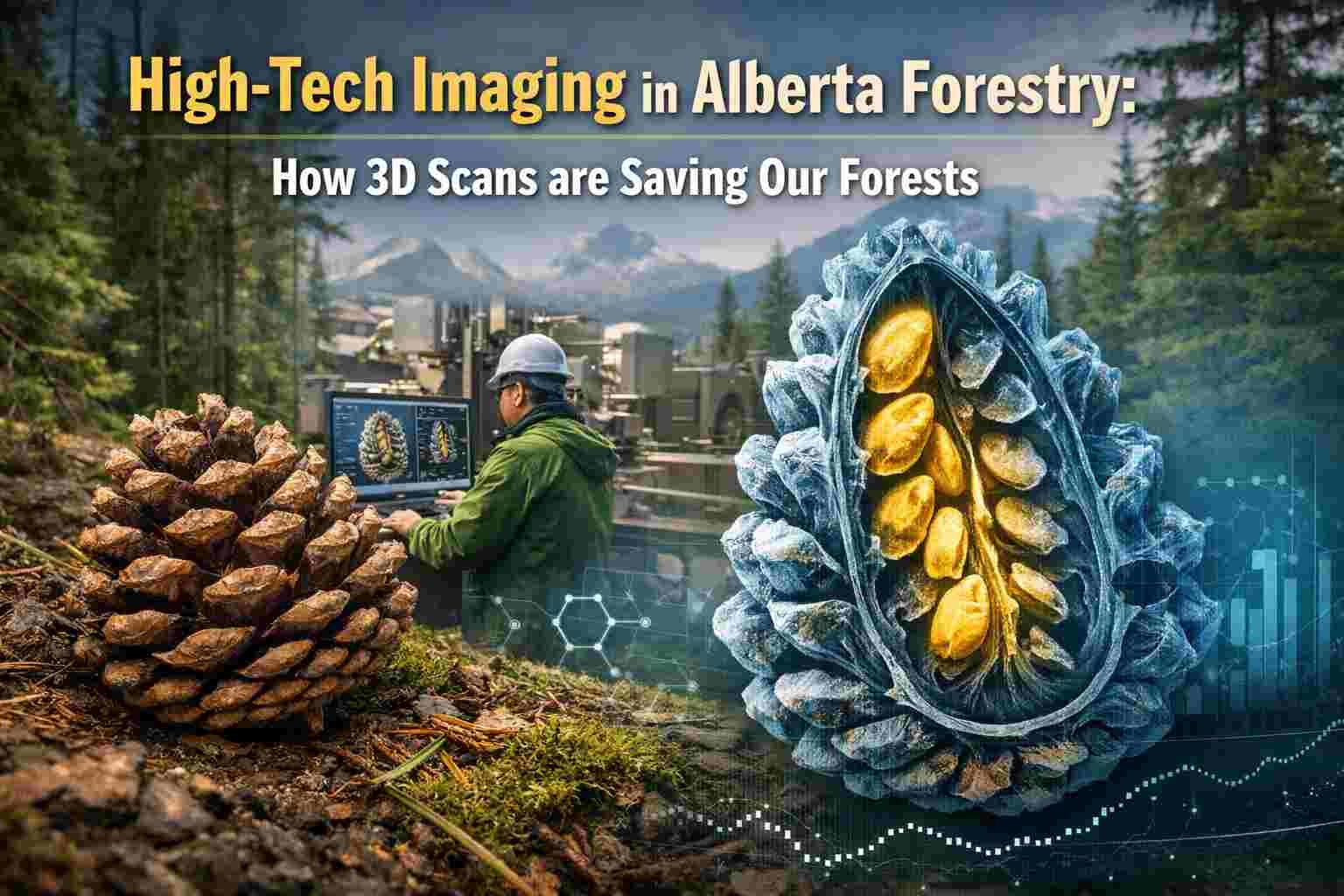
High-Tech Imaging in Alberta Forestry: When we talk about “high-tech,” we usually picture sterile labs, sleek smartphones, or complex AI servers. We rarely think of a muddy pine cone in the middle of a Canadian forest. However, researchers at the University of Alberta are changing that narrative. They are bringing particle physics into the wilderness to solve a problem that has baffled foresters for years: why are our trees struggling to reproduce?
By using advanced 3D imaging technology—the kind usually reserved for medical breakthroughs or aerospace engineering—scientists are finally getting a look at the “hidden” life of forests.
The Secret World Inside a Pine Cone
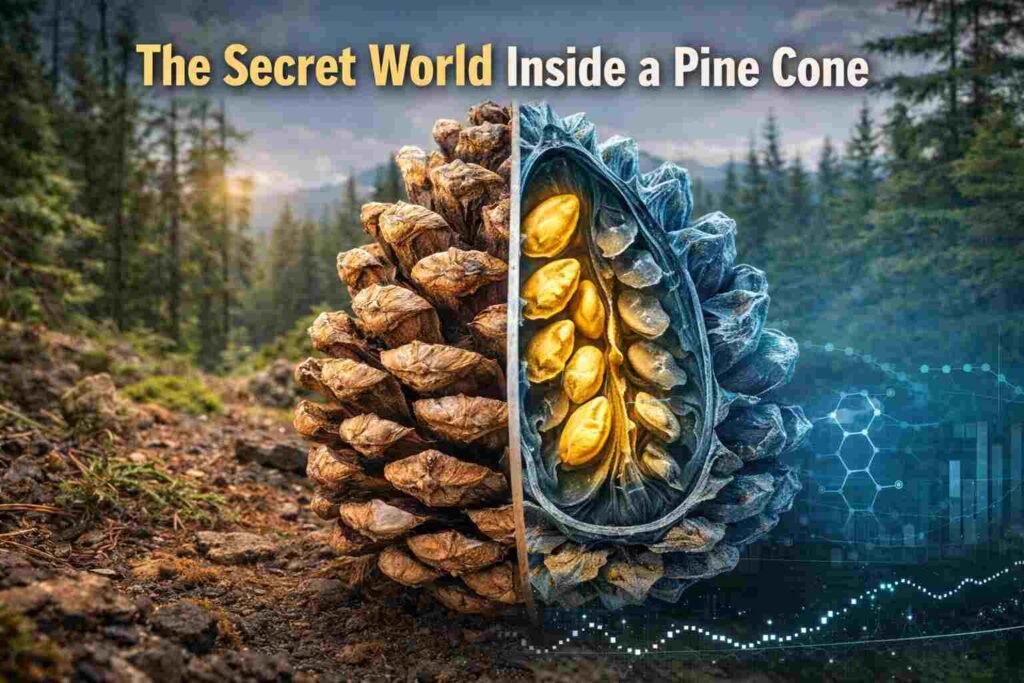
For decades, if you wanted to know why a pine cone wasn’t producing healthy seeds, you had to cut it open. The problem? Once you cut it, you’ve destroyed the very thing you’re trying to study. It’s like trying to understand how a watch works by smashing it with a hammer.
Enter the Synchrotron
The University of Alberta team, led by researcher Victor Wong, turned to something much more sophisticated: Synchrotron Microcomputed Tomography.
Think of this as a CT scan on steroids. By using high-energy X-rays, researchers can create incredibly detailed 3D reconstructions of a pine cone’s interior. They can see every seed, every nutrient vein, and every microscopic defect without ever damaging the cone. This allows them to watch the “internal architecture” of nature in a way that was physically impossible just a decade ago.
Why Alberta’s Forestry Industry is Bracing for Change
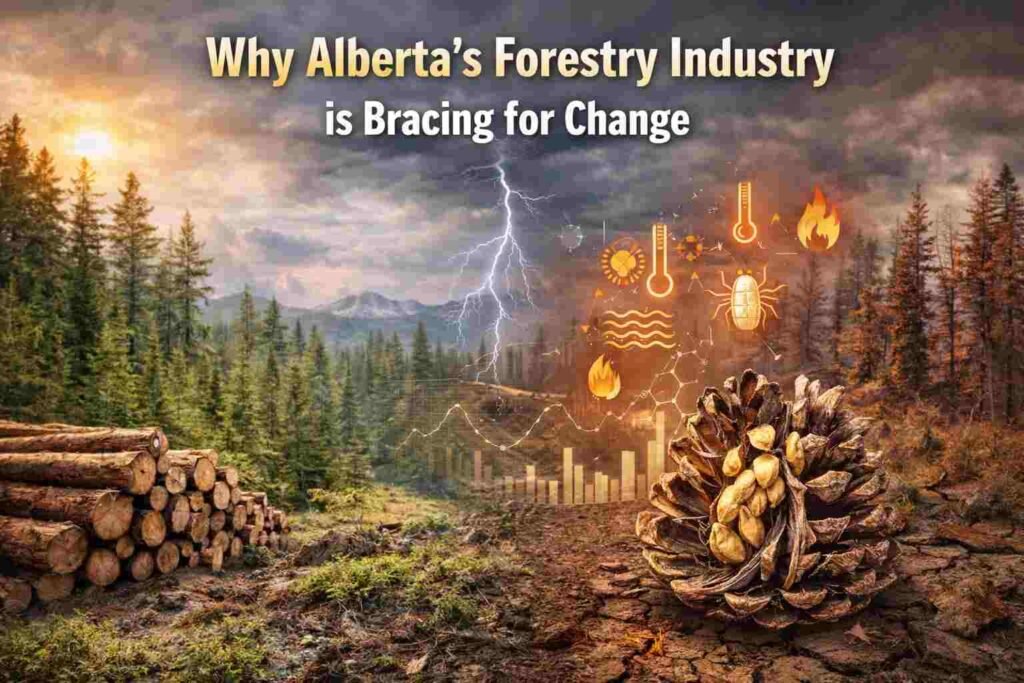
Alberta’s economy and environment rely heavily on its lodgepole pine forests. To keep these forests healthy, the province uses “seed orchards”—essentially high-tech nurseries designed to produce the best possible seeds for replanting.
The Mystery of the Empty Cones
Lately, these orchards have been hitting a wall. Many cones look perfectly healthy on the outside, but when they are harvested, they turn out to be “duds”—empty or containing shriveled, useless seeds.
Using 3D imaging, researchers discovered that the issue often starts far earlier than they realized.
- Nutrient Blockages: The scans showed that sometimes the “pipes” delivering nutrients to the seeds just stop working.
- Pollination Gaps: The tech reveals exactly which seeds were fertilized and which weren’t, helping foresters understand if they need more bees, better wind flow, or different planting patterns.
Bridging the Gap Between Data and Dirt

This isn’t just a science experiment; it’s a data-driven rescue mission. By digitizing the biological process of a tree, we are creating a bridge between traditional forestry and modern data science.
Climate Resilience in the Digital Age
As our climate shifts, the “old rules” of forestry don’t always apply. Some tree lineages that thrived 20 years ago are now struggling with heat or new pests. 3D imaging allows scientists to identify which specific trees are producing the most resilient seeds.
Instead of waiting 30 years to see if a forest survives, we can use this tech to “audit” the health of the seeds today. It’s a proactive way to ensure that the millions of dollars spent on reforestation actually result in a living, breathing forest.
The Bottom Line
The integration of high-energy physics into forestry proves that technology’s greatest value isn’t just in making our lives easier—it’s in protecting the world we live in. By “seeing” the invisible problems inside a single pine cone, Alberta is setting a global standard for how we manage the planet’s most precious resources.
Frequently Asked Questions (FAQs)
Is this technology safe for the trees?
Absolutely. One of the biggest advantages of this 3D imaging is that it is non-destructive. Scientists can scan a cone, analyze its internal structure, and the cone remains completely intact. This allows for more accurate data because the natural state of the sample isn’t altered by saws or chemicals.
Why can’t we just use regular X-rays?
Regular X-rays (like the ones at a dentist) provide a 2D image that lacks the depth and resolution needed for biological research. Synchrotron imaging uses much brighter, more focused light, allowing researchers to see tiny details—down to a few microns—that a standard X-ray would simply miss.
How does this help the average person?
While it seems like “deep science,” the impact is very practical. Better seed research leads to healthier forests. Healthier forests mean better air quality, more stable timber prices for home building, and more effective “carbon sinks” to fight climate change. It’s about securing the long-term health of our environment.
Will this tech be used for other plants too?
Yes! While the current focus in Alberta is on the lodgepole pine, the “blueprint” of using 3D imaging for seed health can be applied to almost any crop. From agriculture to endangered wildflowers, this technology provides a new way to help plants survive in a changing world.
My Website Recent Article: Sarah Court Appointed as ASIC Chair
