


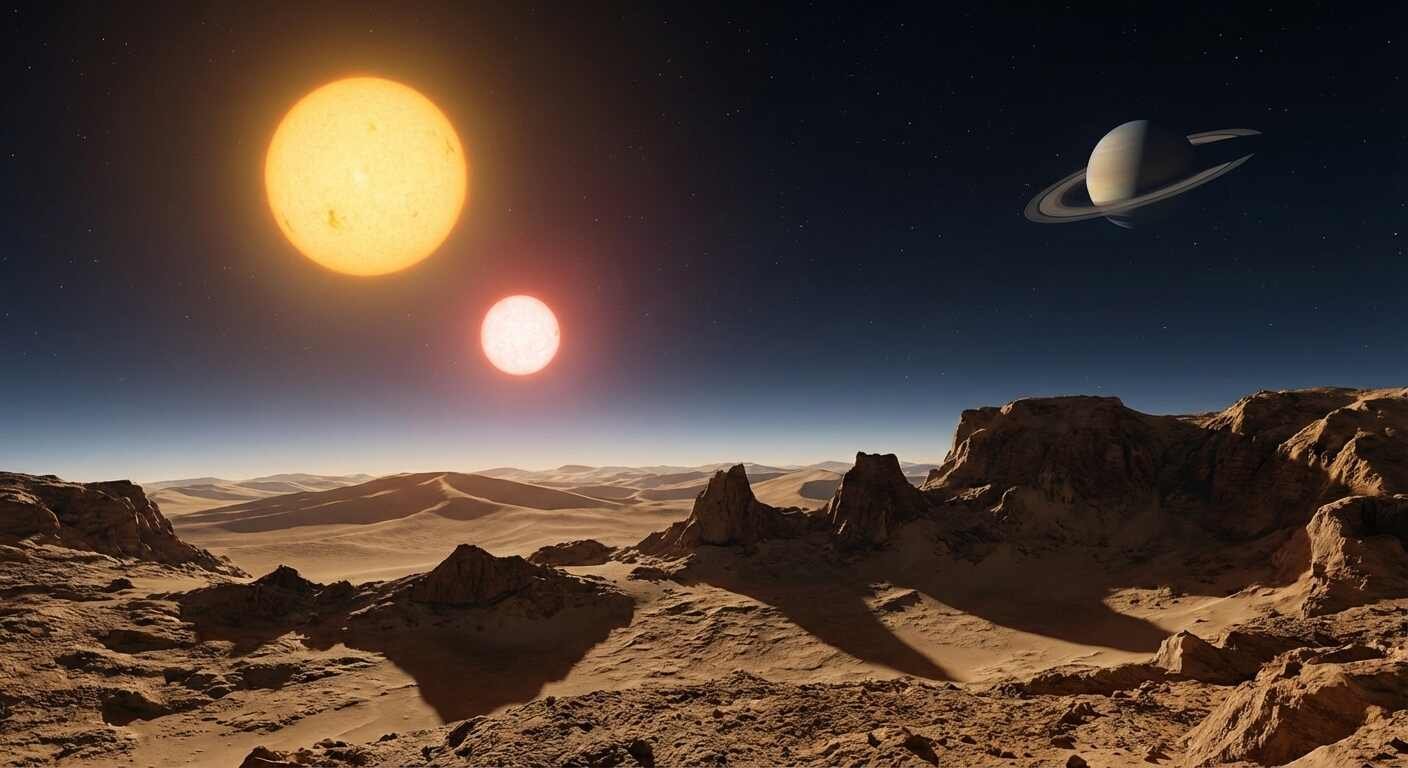
Tatooine planets are still extremely uncommon in our own universe. To date, only 14 planets have been found to orbit binary stars out of more than 6,000 exoplanets discovered. These planets, known colloquially as “Tatooine planets” after Luke Skywalker’s fictional home planet with two suns, pose a serious challenge to their own survival that scientists are only now beginning to grasp.
Planets orbiting two suns face a number of serious challenges to survival that scientists are only now beginning to grasp. In most binary star systems, the two stars are similar but not identical in mass and orbit each other in elliptical orbits. General Relativity, Einstein’s theory of massive objects’ distortions of space and time, adds a further layer of complexity to these systems. As a result, calculations have shown that General Relativistic effects would destabilize eight out of every ten exoplanets in close binary systems, with 75% being utterly annihilated in the process. This explains why there is an “absolute desert” of planets in close binaries with orbital periods of seven days or less. Furthermore, studies have shown that perpendicular disk systems may produce more terrestrial planets than coplanar disk systems, with a mean of 4.8 terrestrial planets for perpendicular disks compared to 3.4 for coplanar disks.
Why So-Called Tatooine Planets Are Rare in Binary Star Systems
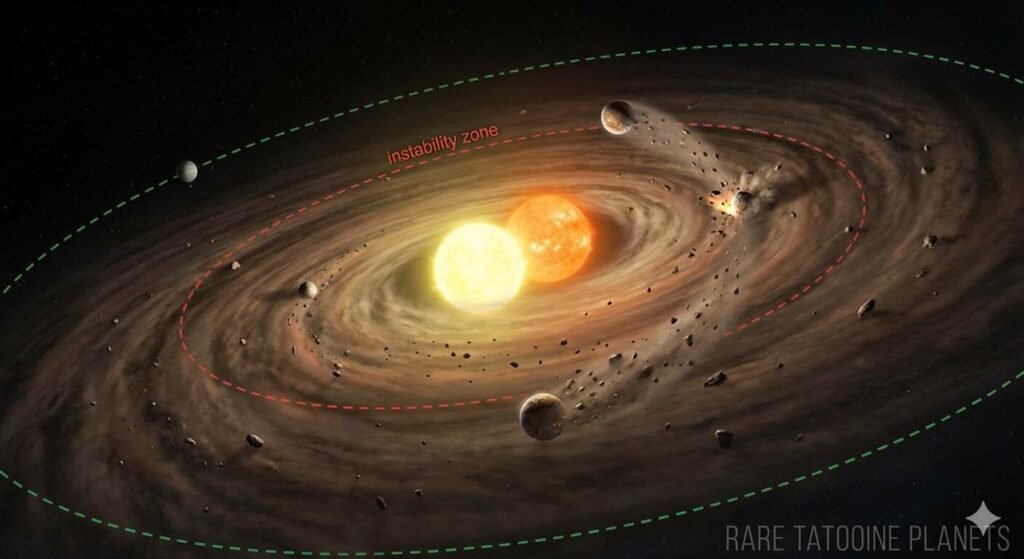
Binary star systems are very challenging environments for planets to form and survive. In fact, scientists expected to find hundreds of circumbinary planets among the 3,000 eclipsing binary stars discovered by Kepler, but only 14 have been confirmed.
The most important observation is what is referred to as the “absolute desert,” which is the absence of planets in binaries with orbital periods below seven days. Additionally, there is an instability region where no planet can exist. In this region, three-body interactions cause the planet to be ejected or to be close enough to be destroyed.
Notably, 12 of the 14 known circumbinary planets lie just beyond this boundary of instability. Their orbital placement indicates that these planets likely migrated from farther away, as the formation of rocky planets near binary stars is extremely challenging. The gravitational influence of two stars makes it impossible for rock and dust particles to stick together and form a planet.
Although about half to three-quarters of all star systems are binary, the disks that could form planets around them are highly disturbed. These disturbances change the conditions under which planets could form, making the existence of Tatooine planets extremely rare, except under very specific conditions.
How General Relativity Disrupts Planetary Orbits
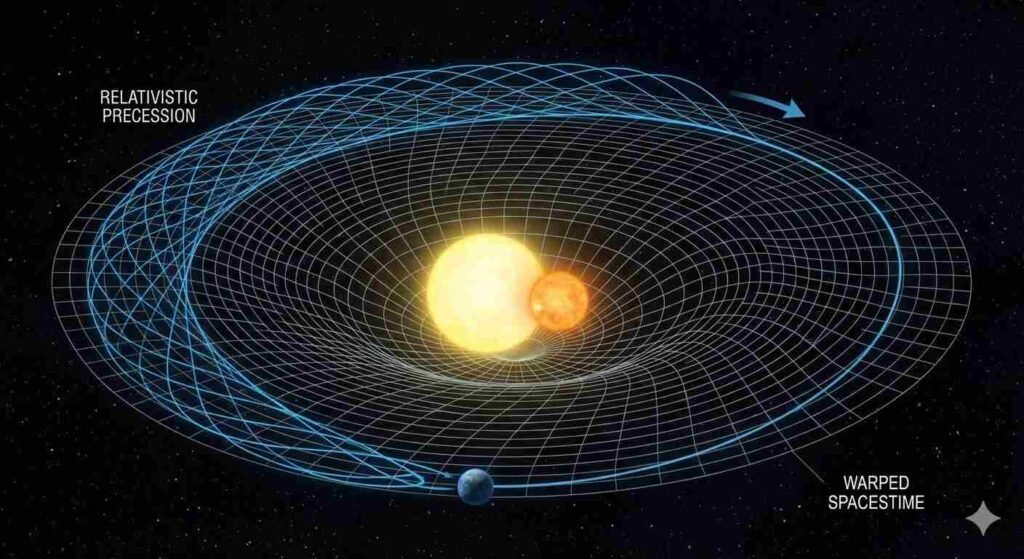
General Relativity dramatically changes the way Tatooine planets are understood through the intricate dynamics of orbital mechanics. According to Einstein’s theory, instead of being a force, gravity is actually the curvature of spacetime caused by the presence of mass, just as a man standing on a trampoline warps its surface.
The orbital paths of binary stars are inherently precessed due to relativistic effects, the presence of non-spherical star shapes, and the gravitational influence of other bodies. This precession causes the periastron, or the point of closest approach between the two stars, to change over time. Notably, as binary stars are tidally drawn closer together, the rate of relativistic precession increases.
At the same time, the orbit of a circumbinary planet also undergoes precession due to the gravitational pull of both stars—but this is a Newtonian, not relativistic, phenomenon. As the binary stars approach each other, the precession of the planet’s orbit actually slows down.
The decisive point is reached when these two precession periods coincide, leading to a resonance. This resonance causes the planet’s orbit to elongate into ever more eccentric ellipses. Finally, the planet’s orbit brings it too close to the binary system at periastron, entering what researchers call the “zone of instability”.
Within this zone, the planet has two possible courses: being thrown out of the system altogether or being catastrophically torn apart by a collision with one of the stars.
Simulation Evidence and the Fate of Tatooine-Like Planets
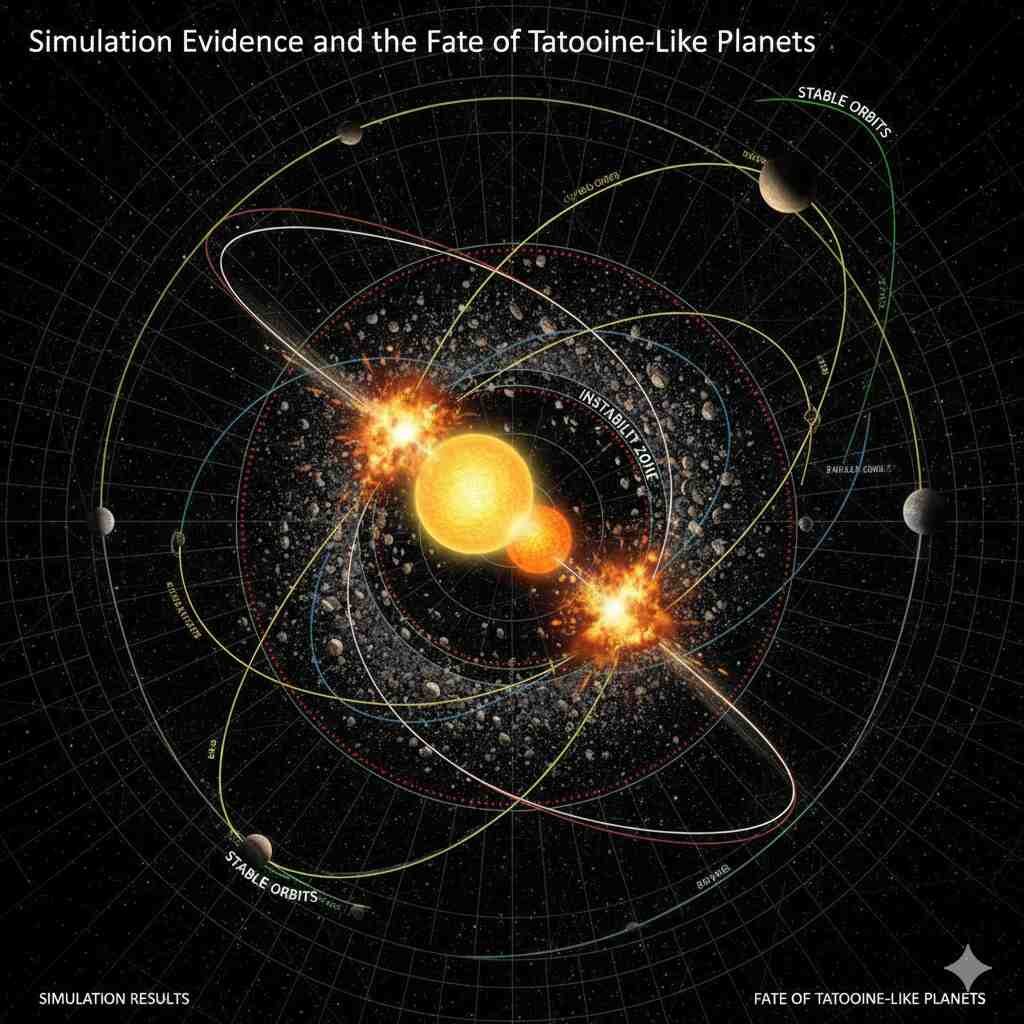
Computer simulations have ascertained the dire consequences of General Relativity on Tatooine planets.
When a planet is trapped in a resonance state, its orbit will become more and more elliptical, precessing at a rapid rate while remaining locked to the binary’s orbital period. Interestingly, planets are threatened with two possible outcomes once they cross the boundary of the instability region: either they are ejected to the outer reaches of the star system or are completely engulfed by one of the stars.
Computer simulations demonstrate that planets can only remain stable if placed outside certain boundaries of stability. Two critical boundaries are identified by research to distinguish between stable, unstable, and mixed regions. The orbital eccentricity of planets is found to be the most important parameter in determining stability, with higher values (above 0.7, in particular) causing the boundaries of stability to shift outward.
It is important to note, however, that some Tatooine planets are surprisingly stable. Five star systems—Kepler-34, -35, -38, -64, and -413—are potentially capable of harboring habitable zones where liquid water might flow. Of these, Kepler-38 is clearly the most promising candidate for hosting a potentially habitable planet.
When planets migrate toward the star, their final location is determined by the disk geometry. Many planets are trapped at the inner boundary, where negative Lindblad torques balance positive corotation torques. This is why most known circumbinary planets orbit just outside the boundary of stability.
Conclusion
The Tatooine planets, although common in science fiction, are actually extremely rare in our universe. The main reason for this is the complicated gravitational dynamics that occur when a planet orbits two stars rather than one. General Relativity, or Einstein’s theory of gravity as the bending of space by massive bodies, further complicates these already unstable systems.
The binary stars and their planets are ultimately caught in a cosmic trap. Stars tend to change their orbits over time through a process called precession. This can be described as their orbits gradually rotating, much like a top spinning and wobbling in slow motion. At the same time, planets orbiting binary star systems also tend to experience precession. When these two processes are in sync, the planet is doomed. Its orbit is stretched until it either collides with one of its suns or is catapulted out of the system.
Computer simulations have made it clear why there is an “absolute desert” of planets orbiting close binary stars. As a result, most Tatooine planets that do exist orbit just beyond the stability boundary, having migrated from a safer, but farther-out, birthplace.
However, it is not uncommon for nature to occasionally turn the odds on their head. Five binary star systems have been identified that may harbor a habitable zone where liquid water could exist, with Kepler-38 being one of the most promising. In addition, studies have indicated that non-traditional systems such as perpendicular disks could actually be more conducive to the formation of terrestrial planets than traditional systems.
While Star Wars enthusiasts may be disappointed that the existence of a planet like Tatooine is so rare in the galaxy, this actually serves to make the existence of such planets all the more special. The physics that makes it impossible for Tatooine planets to exist in large numbers is a testament to the incredible precision that exists in the universe’s design. After all, some of the most interesting scientific discoveries can be found not in what is common, but in understanding why certain phenomena are so rare.
FAQs
Q1. Are planets in binary star systems, such as Tatooine, possible?
Yes, planets in binary star systems are possible, although they are quite rare. The first confirmed circumbinary planet was found in 2011, which disputed the scientific consensus that such planets were unlikely to exist.
Q2. How does General Relativity impact planets in binary star systems?
General Relativity induces orbital precession in binary star systems, which can produce resonances with planetary orbits. This can cause orbit elongation and potentially result in the ejection of planets from the system or a collision with one of the stars.
Q3. Why are Tatooine-like planets so rare?
Tatooine-like planets are rare because the gravitational dynamics of binary star systems make it difficult for planets to form and maintain stable orbits. The cumulative effect of two stars’ gravitational forces can interfere with planet formation and destabilize the orbits of existing planets.
Q4. Are habitable planets possible in binary star systems?
Although difficult, there could be habitable planets in binary star systems. Five binary star systems, including Kepler-38, have been discovered that could possibly harbor a habitable planet where liquid water could exist on the surface.
Q5. What role have computer simulations played in understanding Tatooine-like planets?
Computer simulations have played an important role in understanding the behavior of circumbinary planets. Computer simulations have shown that in a binary star system, 80% of the planets would be unstable, and 75% of them would be completely destroyed.
Explore More from Orbit News Hub: Carlos Alcaraz
